EN
EN



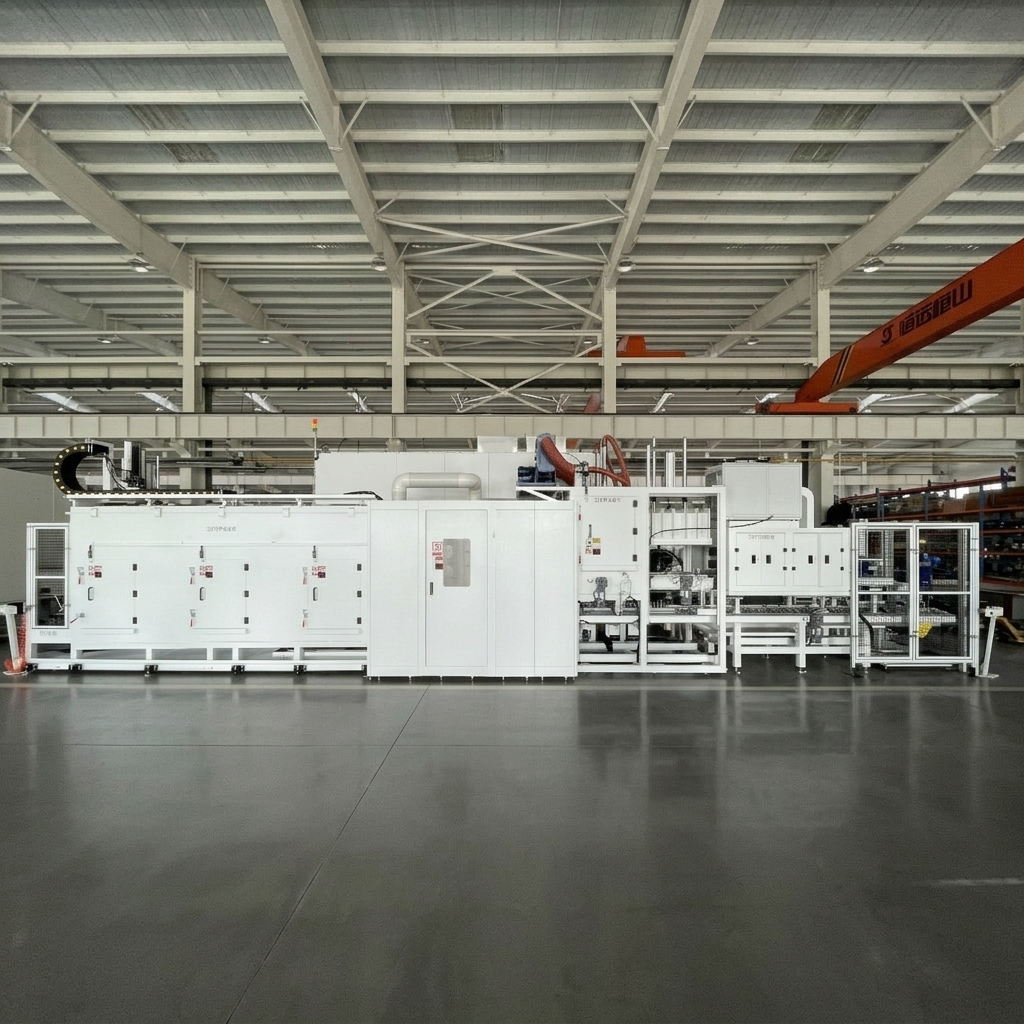
New Energy Vehicle Powertrain Housing Ultrasonic & High-Pressure Cleaning System for NEV Manufacturing
Customized turnkey solution for a major new energy vehicle powertrain component manufacturer
Application: Powertrain Housing Cleaning for New Energy Vehicle Manufacturing
Workpiece: Aluminum Powertrain Housings / NEV Component Housings — Multiple Variants
Cleaning Process: Ultrasonic Cleaning (28 kHz, 2 Stations) + Turbulent Cleaning (1.0 MPa) + High-Pressure Cleaning (50 MPa, Max 53 MPa) + Spray Rinsing (0.6 MPa) + Immersion Turbulent Rinsing + Vacuum Drying (10 mbar) + Cooling
Cleaning Pressure: High-Pressure 50 MPa (Max 53 MPa) / Turbulent 1.0 MPa / Rinsing 0.6 MPa — customizable
Ultrasonic Cleaning: 28 kHz Ultrasonic Cleaning with 2-Station Configuration — customizable
Cleaning Temperature: 35–45°C (Electric Heating) — customizable
Cycle Time: ≤100 seconds per piece (select variants) / ≤120 seconds per piece — customizable per production line requirements
Cleanliness Requirement: Per ISO 16232 with Strict Particle Size Distribution Limits; Total Residue ≤9 mg — customizable per customer requirements
Drying Technology: Vacuum Drying (10 mbar) + Cooling to 24±4°C
Filtration System: Multi-Stage Filtration (50 μm / 20 μm / 5 μm) — customizable
Robot Configuration: 6-Axis Robot (IP67, 210 kg Payload) with Automatic Tool Change — customizable
Loading/Unloading: Manual Loading / Automatic Transfer / Manual Unloading — customizable
Description
New Energy Vehicle Powertrain Housing Ultrasonic & High-Pressure Cleaning System
The Big Bird Industrial Powertrain Housing Cleaning System is developed for post-machining cleaning of aluminum housings used in new energy vehicle powertrain manufacturing. The system removes machining chips, cutting fluid residues, and particulate contamination before final assembly.
The equipment is provided as a turnkey solution including design, manufacturing, installation, and commissioning.
Workpiece Applications
The system accommodates multiple powertrain housing variants:
| Variant | Material | Application |
|---|---|---|
| Variant A | Aluminum Alloy | NEV Powertrain Housing |
| Variant B | Aluminum Alloy | NEV Powertrain Housing |
| Variant C | Aluminum Alloy | NEV Powertrain Housing |
| Variant D | Aluminum Alloy | NEV Powertrain Housing |
All workpieces are aluminum housings for new energy vehicle powertrain applications. The system features a single pallet design compatible with all four variants, eliminating the need for pallet changeover between variants.
Automatic Mixed-Model Production
The system supports automatic mixed-model production with:
Workpiece Identification
Through-beam photoelectric sensors detect workpiece外形 differences for automatic model recognition.
Automatic Tool Change
The system features two gripper sets:
Variants A & B: Shared gripper set
Variants C & D: Shared gripper set
Automatic tool change via quick-change system (1 master plate + 2 sub-plates) for seamless variant switching
Single Pallet Design
One pallet type accommodates all four workpiece variants, eliminating pallet changeover time.
Gantry Robot Transfer
A gantry robot transfers workpieces between stations, enabling efficient two-station ultrasonic cleaning configuration.
Multi-Stage Cleaning Process
The system combines multiple cleaning technologies in an 8-stage automated sequence:
Stage 1: Loading (1ST)
The operator places the workpiece onto the loading trolley pallet. The trolley transfers the workpiece to the gantry robot pick-up position. The gantry robot grips the workpiece and pallet for transfer to the next station.
This station features workpiece presence detection and model recognition via through-beam photoelectric sensors. The single pallet design accommodates all four variants.
Stage 2: Ultrasonic Cleaning (2ST) — 28 kHz
The gantry robot places the pallet-mounted workpiece onto the positioning base within this station. The ultrasonic system activates for thorough cleaning of internal passages and blind holes.
To extend ultrasonic cleaning time, this station features two positions. The gantry robot places the workpiece in one position while retrieving a previously cleaned workpiece from the other position for transfer to the next station.
After robot gripping, the gantry robot returns empty pallets to the loading trolley for the next workpiece.
Stage 3: Turbulent & Fixed-Point Cleaning (3ST) — 1.0 MPa
The cleaning robot transfers the workpiece into the cleaning chamber, submerging it in the turbulent cleaning tank. The robot flexibly changes workpiece orientation to create turbulent flow for thorough surface cleaning.
After turbulent cleaning, the tank drain valve opens for rapid drainage. Nozzle boxes around the tank perimeter perform fixed-point and scanning cleaning of all surfaces. All holes and passages have corresponding nozzles for targeted cleaning. Water passages feature plug cleaning functionality.
After cleaning, the robot transfers the workpiece to the next station.
Stage 4: High-Pressure Cleaning (4ST) — 50 MPa (Max 53 MPa)
The robot transfers the workpiece to the high-pressure cleaning station. The robot changes workpiece orientation to align with high-pressure nozzles for 50 MPa cleaning.
This station features high-pressure deburring capability (positions confirmed during drawing review). Both straight and rotating high-pressure nozzles are configured for comprehensive coverage.
After high-pressure cleaning, the robot transfers the workpiece to the next station.
Stage 5: Comprehensive Rinsing (5ST) — 0.6 MPa
The transfer robot places the workpiece onto the rinsing positioning pallet. Fixed-point nozzle boxes perform spray rinsing while water fills the station, immersing the workpiece in rinsing fluid to create turbulent flow for thorough rinsing.
After rinsing, high-efficiency drying removes surface moisture. The transfer robot places the workpiece onto the outlet positioning pallet with tilt-drainage during transfer, and performs brief blow-drying at fixed nozzles.
This station features two positions to extend rinsing time.
Stage 6: Vacuum Drying (6ST) — 10 mbar
The workpiece and pallet are conveyed into the vacuum chamber. The vacuum hood closes to form a sealed chamber. The vacuum pump evacuates the chamber to 10 mbar, removing residual moisture from all surfaces and internal passages.
After vacuum drying, the vacuum hood opens, and the conveyor transports the workpiece and pallet to the next station.
Stage 7: Cooling (7ST)
The workpiece and pallet are conveyed to the cooling station. Forced air cooling reduces the component temperature to 24±4°C (or 15–20°C when ambient temperature is below 15°C).
Stage 8: Unloading (8ST)
The workpiece and pallet are conveyed to the unloading position. The operator removes the workpiece. This station features workpiece presence detection and safety light curtains for operator protection.
High-Pressure Cleaning Technology
The system features exceptional high-pressure cleaning capability:
| Parameter | Specification |
|---|---|
| Cleaning Pressure | 50 MPa (Max Adjustable 53 MPa) |
| High-Pressure Pump | URACA P3-10-530, 40 L/min, 38 kW |
| Control | VFD control |
| Key Feature | High-pressure deburring capability |
| Nozzle Types | Straight nozzles + Rotating nozzles |
Ultrasonic Cleaning Technology
| Parameter | Specification |
|---|---|
| Frequency | 28 kHz (confirmed during design) |
| Configuration | 2-Station for extended cleaning time |
| Filtration | Paper belt filter (50 μm) for ultrasonic tank |
Technical Cleanliness Control
For new energy vehicle powertrain manufacturing, cleanliness of housing internal passages directly affects component performance and reliability.
The system is designed to meet strict cleanliness requirements:
| Requirement Area | Variant A & B (Per ISO 16232) | Variant C & D |
|---|---|---|
| Total Residue | Per ISO 16232 particle count limits | ≤9 mg |
| Ferrous Particles (600–1000 μm) | 0 per 1000cm² | ≤2 particles |
| Non-Ferrous Particles (600–1000 μm) | 9 per 1000cm² | — |
| Non-Ferrous Particles (1000–1500 μm) | 1 per 1000cm² | — |
| Max Non-Metallic Particle | 1 mm+ (must be non-metallic) | ≤1800 μm |
| Max Fiber Length | — | ≤3000 μm |
| Surface Area | APPX 6,480 cm² | — |
Advanced Filtration Management
The system employs multi-stage filtration for each circuit:
Ultrasonic Cleaning Filtration:
Paper Belt Filter — 500 L/min, 50 μm (1 unit)
Cleaning Circuit Filtration:
Basket Filter — 300 L/min, 40 mesh (4 units)
Bag Filter — 900 L/min, 20 μm (1 active + 1 standby)
In-Line Bag Filter — 300 L/min, 5 μm (1 active + 1 standby)
Rinsing Circuit Filtration:
Basket Filter — 300 L/min, 40 mesh (2 units)
In-Line Bag Filter — 300 L/min, 5 μm (2 active + 1 standby)
All filters feature blockage alarms with manual change capability without production interruption.
Robot System
| Parameter | Specification |
|---|---|
| Robot Model | FANUC R-2000iC/210WE |
| Number | 1 unit |
| Payload | 210 kg |
| Controller | FANUC |
| Key Feature | Damage-free workpiece handling |
Application Case
| Parameter | Specification |
|---|---|
| Project | Major NEV Powertrain Component Manufacturer — Powertrain Housing Cleaning System |
| Workpiece | Multiple Aluminum Housing Variants for NEV Powertrain (4 Variants) |
| Cycle Time | Variants A & B: 100s/piece / Variants C & D: 120s/piece |
| Cleaning Technologies | Ultrasonic 28 kHz + Turbulent 1.0 MPa + HP 50 MPa (Max 53 MPa) + Rinsing 0.6 MPa + Vacuum Drying 10 mbar |
| Cleaning Temperature | 35–45°C |
| Robot | FANUC R-2000iC/210WE, IP67, 210 kg |
| Control System | Mitsubishi PLC |
| Tank Capacity | 5,000 L (1,000 + 2,000 + 1,000 + 1,000 L) |
| Total Power | 205 kW (including 90 kW heaters) |
| Footprint | 13,500 × 7,400 mm |
Complete Cleaning Solution
Big Bird Industrial provides comprehensive engineering solutions including:
Process Development
Component analysis for NEV powertrain housings
Cleaning process design
Cleanliness requirement evaluation per ISO 16232
Equipment Integration
Ultrasonic cleaning systems (28 kHz, 2 stations)
High-pressure cleaning (50 MPa, max 53 MPa)
Vacuum drying technology (10 mbar)
Automatic tool change systems
Multi-stage filtration management
Conveyor and pallet handling systems
Smart Manufacturing Connection
MES interface
Production data acquisition
Why Choose Big Bird Industrial
New Energy Vehicle Component Experience
Big Bird Industrial specializes in precision cleaning solutions for automotive and new energy vehicle powertrain components, with proven experience in housing cleaning for multiple NEV applications.
High-Pressure Cleaning Technology (50 MPa)
The system delivers high-pressure cleaning up to 50 MPa (max 53 MPa) with high-pressure deburring capability — one of the highest pressure systems available — ensuring effective removal of stubborn contaminants and burrs from complex housing geometries.
Ultrasonic + High-Pressure Combined Technology
The system integrates ultrasonic cleaning (28 kHz) and high-pressure cleaning (50 MPa) in a single production sequence, enabling thorough cleaning of both internal blind holes and external surfaces.
System-Level Engineering Capability
The company provides complete solutions from cleaning process development to production integration, including ultrasonic cleaning, high-pressure cleaning, vacuum drying, and MES connectivity.
Customized Non-Standard Engineering
Each component and production line has unique requirements. Big Bird Industrial provides customized engineering solutions based on:
Component structure and material analysis
Cleaning process development
Customized fixture and automation design
Automatic tool change configuration
Factory layout and production flow integration
FAQ
What components does this cleaning system process?
This system is designed for aluminum powertrain housings used in new energy vehicle manufacturing — four variants with single pallet compatibility and automatic tool change.
What cleaning pressure is available?
The system delivers high-pressure cleaning up to 50 MPa (max adjustable 53 MPa) with high-pressure deburring capability.
What cleaning technologies are integrated?
The system integrates ultrasonic cleaning (28 kHz, 2 stations), turbulent cleaning (1.0 MPa), high-pressure cleaning (50 MPa), spray rinsing, vacuum drying (10 mbar), and cooling.
What contaminants can be removed?
It removes metal chips, cutting fluid residues, and particulate contamination from complex internal passages and external surfaces.
What cleanliness levels can be achieved?
Per ISO 16232 for two variants with strict particle size distribution limits; total residue ≤9 mg for the other two variants with maximum particle size limits of 1,000–1,800 μm.
How are different variants handled?
The system features automatic model recognition, single pallet design (no pallet changeover), and automatic tool change between gripper sets.
Powertrain Housing Cleaning in New Energy Vehicle Manufactur
Powertrain Housing Cleaning in New Energy Vehicle Manufacturing
Powertrain housing cleaning is a critical process in new energy vehicle manufacturing. Aluminum housings with complex internal geometries require advanced cleaning technologies to remove metal chips, cutting fluid residues, and particulate contamination. Ultrasonic cleaning reaches internal cavities and blind holes that conventional spray cleaning cannot access, while high-pressure cleaning delivers the cleaning power needed for stubborn contaminants.
Ultrasonic & High-Pressure Combined Cleaning for NEV Components
NEV powertrain housings present unique cleaning challenges due to their complex geometries and strict cleanliness requirements. Combined ultrasonic cleaning (28 kHz) and high-pressure cleaning (50 MPa) technology ensures thorough removal of contaminants from both internal blind holes and external surfaces. Two-station ultrasonic configurations enable extended cleaning times without impacting overall production throughput.
High-Pressure Deburring Technology (50 MPa)
High-pressure cleaning at 50 MPa (max 53 MPa) with deburring capability provides superior contaminant and burr removal for precision NEV powertrain components. The extreme pressure effectively removes stubborn machining burrs and particulate contamination from complex internal passages that conventional cleaning cannot address, improving component quality and assembly reliability.
Filtration Management in NEV Component Cleaning
Effective filtration is essential for maintaining consistent cleaning quality in NEV component manufacturing. Multi-stage filtration configurations with paper belt filters, basket filters, and bag filters (down to 5 μm) ensure cleaning fluid quality is maintained. Blockage alarms with non-stop change capability enable continuous operation without production interruptions.
Technical Specifications
| Specification | Description |
|---|---|
| Product Type | NEV Powertrain Housing Ultrasonic & High-Pressure Cleaning System |
| Application | New Energy Vehicle Powertrain Housing Cleaning |
| Workpiece | Multiple Aluminum Housing Variants for NEV Powertrain |
| Cleaning Technology | Ultrasonic (28 kHz) + Turbulent (1.0 MPa) + HP (50 MPa, Max 53 MPa) + Rinsing (0.6 MPa) + Vacuum Drying (10 mbar) |
| Cleaning Temperature | 35–45°C (Electric Heating) |
| Cycle Time | ≤100s / ≤120s per piece (variant dependent) — customizable |
| Robot Model | FANUC R-2000iC/210WE |
| Robot Payload | 210 kg |
| High-Pressure Pump | URACA P3-10-530, 40 L/min, MAX 53 MPa, 38 kW |
| Vacuum Pump | Leybold SV220B, 200 m³/h, 4 kW |
| Control System | Mitsubishi PLC |
| HMI | Mitsubishi GT2710-STBD |
| Tank Capacity | 5,000 L (1,000 + 2,000 + 1,000 + 1,000 L) |
| Filtration System | Multi-Stage: Paper Belt (50 μm) / Basket (40 mesh) / Bag (20 μm / 5 μm) |
| Total Power | 205 kW (including 90 kW heaters) |
| Compressed Air | 2 Nm³/min |
| Water Consumption | 5,000 L |
| Noise Level | ≤85 dB (at 1 meter) |
| Footprint | 13,500 × 7,400 mm |