EN
EN


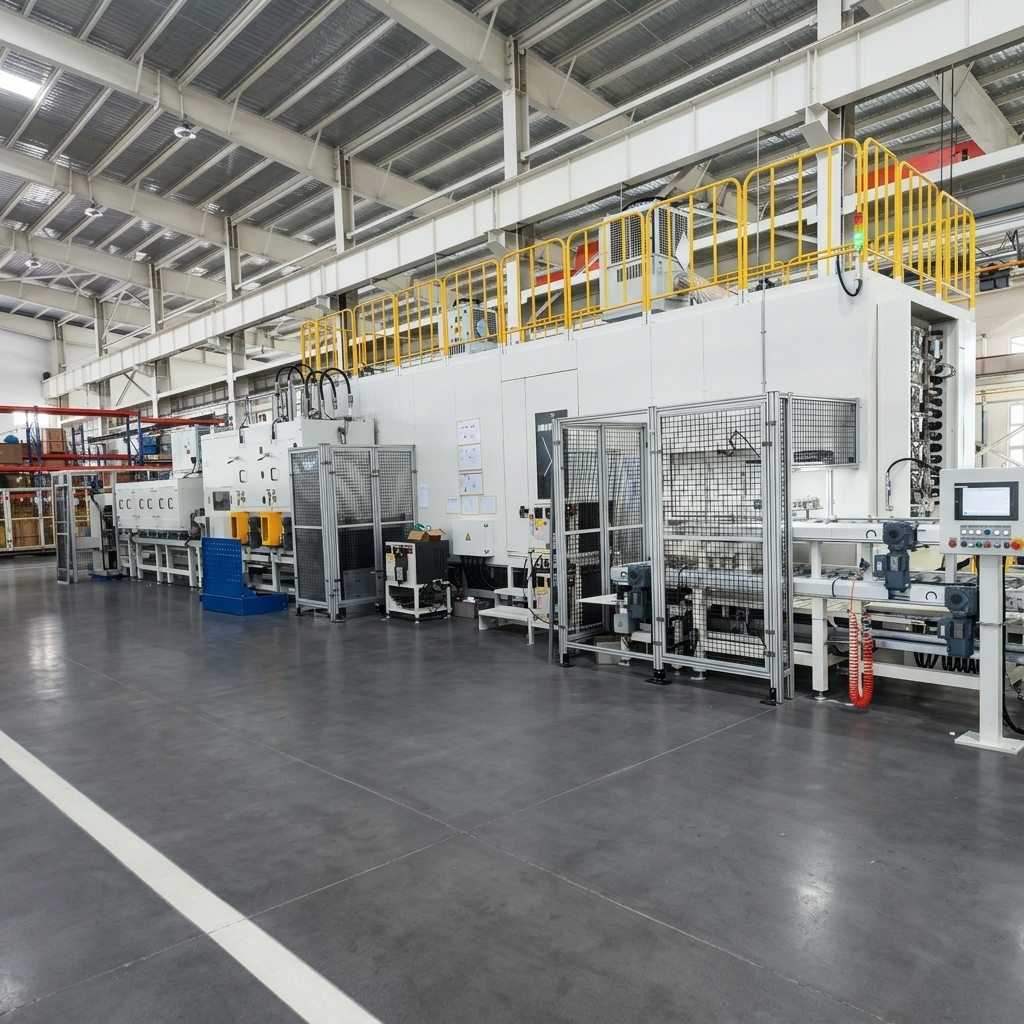
New Energy Vehicle Integrated E-Drive Housing Robotic Cleaning System for Electric Powertrain Manufacturing
Customized turnkey solution for a major new energy vehicle powertrain component manufacturer
Application: Integrated E-Drive Housing / Dual-Motor Integrated Housing Cleaning for NEV Electric Powertrain Manufacturing
Workpiece: Multiple E-Drive Housing Variants (Aluminum Alloy)
Cleaning Process: Turbulent Cleaning (1.5 MPa) + Rotary High-Pressure Cleaning (40 MPa) + Ultrasonic Cleaning (2 Stations) + Fixed-Point High-Pressure Cleaning (40 MPa) + Spray Rinsing (2 Stages) + Blow-Drying (2 Stages) + Vacuum Drying + Cooling
Cleaning Pressure: 40 MPa (High-Pressure) / 1.5 MPa (Turbulent) — customizable
Ultrasonic Cleaning: 2-Station Ultrasonic Cleaning — customizable
Cleaning Temperature: 35–45°C (Electric Heating) — customizable
Cycle Time: ≤ 60 seconds per piece (select variants up to 80s) — customizable per production line requirements
Cleanliness Requirement: Total Residual Contamination ≤ 7.2 mg / ≤ 9.3 mg (per variant); Particle Size Distribution Strictly Controlled; DIN 8296 Surface Tension ≥ 32–36 mN/m — customizable per customer requirements
Drying Technology: Fixed-Point Blow-Drying + Vacuum Drying + Cooling to 20±3°C
Filtration System: Multi-Stage Filtration (50 μm / 20 μm / 10 μm) with Automatic Oil Separation — customizable
Robot Configuration: 6-Axis Robots (3 pcs) with Automatic Tool Change +夹具 Library (4夹具 per robot) — customizable
Loading/Unloading: Automatic Loading & Unloading
Description
New Energy Vehicle Integrated E-Drive Housing Robotic Cleaning System
The Big Bird Industrial Integrated E-Drive Housing Robotic Cleaning System is developed for post-machining cleaning of aluminum housings used in new energy vehicle electric powertrain manufacturing. The system removes machining and casting residues before final assembly and supports mixed-model production with automatic tool change for multiple workpiece variants.
The equipment is provided as a turnkey solution including design, manufacturing, installation, and commissioning.
Workpiece Applications
The system accommodates multiple integrated e-drive housing variants for new energy vehicle applications:
| Category | Material | Typical Cleanliness Requirement |
|---|---|---|
| Motor End Cover / Reduction Gear Housing | ADC12 (Aluminum) | Total residue ≤ 7.2–9.3 mg / Particles < 0.6 mm |
| Inverter Housing / Front & Rear Covers | SiAl12Fe (Aluminum) | Strict particle size distribution control |
| Motor Housing | ADC12 (Aluminum) | Total residue ≤ 7–9 mg / Max particle 0.5 mm |
All workpieces are aluminum housings for new energy vehicle electric powertrain applications. The system is designed with automatic tool change capability, accommodating multiple workpiece variants through a夹具库 system.
Automatic Tool Change & Mixed-Model Production
The system supports fully automatic mixed-model production with:
QR Code Recognition
A COGNEX QR code scanning system automatically reads workpiece identification upon loading. The system selects the appropriate cleaning program based on the QR code information.
Vision Inspection System
A COGNEX vision system identifies workpiece type and orientation, guiding the robot for precise gripping and handling.
Automatic Tool Change
Each robot is equipped with an automatic tool changer (Stäubli) and a夹具库 capable of storing 4夹具 sets. The system automatically changes夹具 based on workpiece identification, enabling seamless mixed-model production without manual intervention.
Three-Robot Configuration
The system utilizes three FANUC robots with coordinated workflow:
Robot 1: Turbulent cleaning + Rotary high-pressure cleaning
Robot 2: Ultrasonic cleaning handover + Fixed-point high-pressure cleaning
Robot 3: Primary rinsing handling + Secondary rinsing + Blow-drying
Multi-Stage Cleaning Process
The system combines multiple cleaning technologies in an 11-stage automated sequence:
Stage 1: Loading
The overhead gantry robot from the automatic line automatically loads the workpiece onto the cleaning system loading pallet. The conveyor system transports the workpiece and pallet to the robot pick-up position.
The loading station features:
Automatic QR code scanning for workpiece identification (COGNEX)
Vision system for workpiece type and orientation recognition (COGNEX)
Two-hand start buttons, emergency stop, and safety light curtains
Automatic air blow-off of empty pallet locating seats after robot pick-up
Compatibility with both manual and automatic loading modes
Lifting roller conveyors at both ends for automatic pallet circulation
Stage 2: Turbulent & Fixed-Point Cleaning (1.5 MPa)
Robot 1 grips the workpiece and transfers it into the turbulent cleaning tank, which has been pre-filled with cleaning fluid. The robot flexibly changes workpiece orientation while nozzles direct turbulent flow to clean all surfaces.
During turbulent cleaning, the robot夹具 engages water jacket hole plugs to prevent aluminum chips from entering the water jacket cavity during cleaning.
After turbulent cleaning, the drain valve opens for rapid drainage. The robot positions the workpiece at fixed nozzle boxes arranged according to the workpiece hole patterns. The robot changes workpiece orientation to align each surface with corresponding nozzle panels, ensuring all holes receive targeted cleaning.
After cleaning, the robot transfers the workpiece to the next station with tilt-drainage during transfer. The cleaning pump continues filling the turbulent tank so it is ready for the next workpiece.
Stage 3: Rotary High-Pressure Cleaning (40 MPa)
Robot 1 transfers the workpiece to the rotary high-pressure cleaning station. Rotating high-pressure nozzles deliver 40 MPa cleaning power to targeted areas of the workpiece. After cleaning, the robot transfers the workpiece to the next station with tilt-drainage during transfer.
Stage 4: Ultrasonic Cleaning
Robot 1 transfers the workpiece to the ultrasonic cleaning station positioning pallet. The ultrasonic tank cover closes automatically during cleaning. This station features two positions, allowing each workpiece to undergo two ultrasonic cleaning cycles.
After ultrasonic cleaning, Robot 2 grips the workpiece from the positioning pallet and transfers it to the next station. For model changeover, the positioning pallet is manually replaced with a simple, lightweight design featuring hard error-proofing.
Stage 5: Fixed-Point High-Pressure Cleaning (40 MPa)
Robot 2 transfers the workpiece to the fixed-point high-pressure cleaning station. Linear fixed-point high-pressure nozzles deliver 40 MPa cleaning power to targeted areas. After cleaning, the robot transfers the workpiece to the next station with tilt-drainage during transfer. A brief air blow removes excess cleaning fluid before the workpiece enters the next station.
Stage 6: Primary Spray Rinsing
Robot 2 places the workpiece on the positioning pallet in this station and retracts. The station door closes, and the nozzle box descends to perform spray rinsing on the workpiece. Dedicated nozzles provide water jacket plug rinsing for specific housings.
After rinsing, the nozzle box returns to its original position, the station door opens, and Robot 3 removes the workpiece and transfers it to the next station. For model changeover, the positioning pallet is manually replaced with a simple, lightweight design featuring hard error-proofing.
Stage 7: Secondary Spray Rinsing
Robot 3 grips the workpiece and performs secondary spray rinsing. Dedicated nozzles provide water jacket plug rinsing for specific housings (cleaning direction opposite to Stage 6). After rinsing, Robot 3 transfers the workpiece to the next station.
Stage 8: Fixed-Point Blow-Drying
Robot 3 performs tilt-drainage during transfer, then positions the workpiece at fixed nozzle boxes arranged according to the workpiece hole patterns. Compressed air provides targeted blow-drying of all holes and passages.
Dedicated water hole plug nozzles provide plug blow-drying for specific housings, ensuring water jacket fluid can drain completely. After fixed-point blow-drying, the robot performs scanning blow-drying across workpiece surfaces. After drying, Robot 3 places the workpiece onto the clean, dried positioning pallet at the outlet.
Stage 9: Secondary Blow-Drying
The workpiece and pallet are conveyed to this station. The station door closes, and nozzle boxes perform blow-drying on both workpiece and pallet. This station features an automatic cleaning/drying program for pallets, with cleaning and blow-drying lines that can be automatically switched.
Stage 10: Vacuum Drying
The workpiece is conveyed into the vacuum chamber. The upper vacuum hood extends via cylinder actuation, enclosing the workpiece in a sealed chamber. The vacuum pump evacuates the chamber, removing residual moisture from internal cavities and blind holes.
Stage 11: Cooling & Unloading
The workpiece is conveyed to the unloading point. Cooling fans reduce the component temperature to 20±3°C at the outlet. The outlet can hold up to 4 workpieces in queue. All outlet conveyors feature protective covers to prevent secondary contamination. Lifting roller conveyors at both ends return empty pallets to the robot placement position via the lower-layer conveyor. The system reserves space for future addition of a pallet cleaning and drying station.
Technical Cleanliness Control
For new energy vehicle electric powertrain manufacturing, cleanliness of e-drive housing internal passages directly affects the performance and reliability of electric drive units.
The system is designed to meet strict cleanliness requirements for each workpiece variant:
| Requirement Area | Typical Specification |
|---|---|
| Total Residual Contamination | ≤ 7.2 mg / ≤ 9.3 mg (per variant) |
| Maximum Particle Size | < 0.6 mm |
| Particle Size Distribution | Strict control per variant specification |
| Surface Tension (DIN 8296) | > 32–36 mN/m (machined surfaces) |
| Visual Inspection | No visible chips or residues in cavities |
Drying quality is verified by wiping workpiece surfaces with filter paper — no visible moisture marks, and no water mist when blowing air through all hole types.
Advanced Filtration Management
The system employs a multi-stage filtration system:
| Filter Type | Capacity | Accuracy | Application |
|---|---|---|---|
| Drum Filter | 1,500 L/min | 50 μm | Primary cleaning filtration with auto-backflush and chip cart |
| Bag Filter | 400 L/min | 20 μm | Secondary cleaning filtration (3 active + 1 standby) with blockage alarm |
| Drum Filter | 300 L/min | 40 mesh | Primary rinsing filtration with level switch and blockage alarm |
| Bag Filter | 400 L/min | 10 μm | Secondary rinsing filtration (1 active + 1 standby) with blockage alarm |
All filters feature blockage pre-alarm and alarm functions. Float-type oil skimmer and belt-type oil skimmer remove floating oil from cleaning fluid to extend fluid life.
Robot System
The system utilizes three FANUC robots:
| Robot | Application | Model | Payload | Protection |
|---|---|---|---|---|
| Robot 1 | Turbulent cleaning / Rotary HP cleaning | R-2000iC/210WE | 210 kg | IP67 |
| Robot 2 | Ultrasonic handover / Fixed-point HP cleaning | R-2000iC/210WE | 210 kg | IP67 |
| Robot 3 | Primary rinsing / Secondary rinsing / Blow-drying | R-2000iC/210WE | 210 kg | IP67 |
All robots are fully waterproof with IP67 protection, rust-proof construction, and sealed sensors. Each robot features an automatic tool changer (Stäubli) and access to a夹具库 with 4夹具 sets. Repetitive positioning accuracy ≤ ±0.2 mm.夹具 clamping surfaces and locating pins avoid using machined surfaces (except process surfaces and holes).
Intelligent Manufacturing Integration
The system supports Industry 4.0 requirements through comprehensive data connectivity:
MES Communication
PLC equipped with MES network interface module
Ethernet communication support
QR code-based workpiece tracking
Production data acquisition
Operator Interface
Mitsubishi touch screen HMI
Real-time equipment status display with graphic visualization
Cleaning parameter display and adjustment
Audible and visual alarms with 500+ alarm history storage (time, address, cause, solution)
Automatic and manual operation modes with interlock protection
Smart Features
Weekend automatic circulation function to prevent fluid degradation
Remote diagnostic capability
Data backup and network connection interface
Application Case
| Parameter | Specification |
|---|---|
| Project | Major NEV Powertrain Component Manufacturer — Integrated E-Drive Housing Robotic Cleaning System |
| Workpiece | Multiple E-Drive Housing Variants for Electric Powertrain (9 Variants) |
| Cycle Time | ≤ 60 seconds per piece (select variants up to 80s) |
| Cleaning Technologies | Turbulent 1.5 MPa + Rotary HP 40 MPa + Ultrasonic (2 stations) + Fixed-Point HP 40 MPa + Rinsing (2 stages) + Blow-Drying (2 stages) + Vacuum Drying |
| Cleaning Temperature | 35–45°C |
| Drying Method | Blow-Drying + Vacuum Drying + Cooling |
| Cooling Result | 20±3°C |
| Robots | FANUC R-2000iC/210WE (3 pcs, IP67) with Automatic Tool Change |
| 夹具 Library | 4夹具 per robot |
| Control System | Mitsubishi PLC |
| Filtration Accuracy | 50 μm / 20 μm / 10 μm |
Complete Cleaning Solution
Big Bird Industrial provides comprehensive engineering solutions including:
Process Development
Component analysis
Cleaning process design
Cleanliness requirement evaluation
Equipment Integration
Multi-robot coordinated cleaning systems
High-pressure cleaning technology (40 MPa)
Ultrasonic cleaning systems (2 stations)
Vacuum drying technology
Automatic tool change systems with夹具库
Multi-stage filtration management
Conveyor and material handling systems
Smart Manufacturing Connection
MES interface
QR code traceability
Production data acquisition
Why Choose Big Bird Industrial
New Energy Vehicle Component Experience
Big Bird Industrial specializes in precision cleaning solutions for automotive powertrain components, with proven experience in new energy vehicle e-drive housing cleaning for multiple electric powertrain applications across 9 workpiece variants.
Multi-Robot Cleaning Technology
The system utilizes three coordinated FANUC robots with automatic tool change capability and夹具库 storage, enabling efficient cleaning of complex e-drive housing geometries with multiple cleaning technologies in a single production sequence.
Integrated Cleaning Technologies
The system combines turbulent cleaning (1.5 MPa), rotary high-pressure cleaning (40 MPa), two-station ultrasonic cleaning, fixed-point high-pressure cleaning (40 MPa), two-stage spray rinsing, two-stage blow-drying, and vacuum drying for comprehensive contaminant removal.
System-Level Engineering Capability
The company provides complete solutions from cleaning process development to production integration, including multi-robot coordination, high-pressure cleaning, ultrasonic cleaning, vacuum drying, and automatic tool change systems.
Customized Non-Standard Engineering
Each component and production line has unique requirements. Big Bird Industrial provides customized engineering solutions based on:
Component structure and material analysis
Cleaning process development
Customized夹具 and automation design
Automatic tool change system configuration
Factory layout and production flow integration
The company's non-standard engineering capability allows each cleaning system to be tailored to specific component geometry, cycle time requirements, cleanliness standards, and automation level.
Electric Powertrain Manufacturing Support
With the rapid growth of new energy vehicles, Big Bird Industrial provides specialized cleaning solutions for electric powertrain components, supporting manufacturers in the transition to electrified production.
FAQ
What components does this cleaning system process?
This system is designed for integrated e-drive housings and electric powertrain components used in new energy vehicle manufacturing, including motor end covers, reduction gear housings, inverter housings, front/rear covers, and motor housings.
What cleaning technologies are integrated?
The system integrates turbulent cleaning (1.5 MPa), rotary high-pressure cleaning (40 MPa), two-station ultrasonic cleaning, fixed-point high-pressure cleaning (40 MPa), two-stage spray rinsing, two-stage blow-drying, vacuum drying, and cooling.
How does the system handle multiple workpiece variants?
The system features automatic QR code recognition, vision inspection for orientation, and an automatic tool change system with a夹具库 for each robot (4夹具 per robot), enabling seamless mixed-model production across 9 workpiece variants.
What contaminants can be removed?
It removes metal chips, casting residues, machining particles, and cutting fluid contamination from complex internal passages, water jackets, and external surfaces.
What cleanliness levels can be achieved?
Cleanliness requirements vary by component specification, typically ranging from 7.2 mg to 9.3 mg total residual contamination with strict particle size distribution control and surface tension requirements per DIN 8296 (≥ 32–36 mN/m).
Is the system customizable?
Yes. All parameters—including cycle time, cleaning pressure, temperature, automation level, and filtration configuration—are customizable per customer production line requirements.
E-Drive Housing Cleaning in New Energy Vehicle Manufacturing
E-Drive Housing Cleaning in New Energy Vehicle Manufacturing
Integrated e-drive housing cleaning is a critical process in new energy vehicle electric powertrain manufacturing. These complex aluminum housings combine multiple functions—motor, inverter, and reducer—in a single component, requiring advanced cleaning technologies to remove machining residues and casting contaminants from intricate internal passages, water jackets, and cooling channels. Cleanliness of e-drive components directly affects the performance, efficiency, and reliability of electric drive units.
Multi-Robot Cleaning Systems with Automatic Tool Change
Electric powertrain component manufacturing demands flexible, high-efficiency cleaning solutions capable of handling multiple workpiece variants. Multi-robot cleaning systems with automatic tool change capability enable seamless mixed-model production without manual intervention. Coordinated robot workflows optimize cleaning sequences, reducing cycle times while ensuring consistent cleaning quality across all variants.夹具 libraries with 4夹具 per robot provide flexibility for up to 9 workpiece variants.
Ultrasonic & High-Pressure Cleaning for Complex Housings
Complex e-drive housings with intricate internal geometries present unique cleaning challenges. Ultrasonic cleaning reaches internal cavities and blind holes that conventional spray cleaning cannot access, while high-pressure cleaning (40 MPa) effectively removes stubborn residues from external surfaces and oil passages. Two-station ultrasonic cleaning enables extended cleaning cycles without impacting overall production throughput.
Filtration and Fluid Management in E-Drive Housing Cleaning
Effective filtration and fluid management are essential for maintaining consistent cleaning quality in e-drive housing cleaning. Multi-stage filtration configurations with drum filters (50 μm), bag filters (20 μm / 10 μm), and oil separation enable continuous operation with automatic filter change alerts. Filtration accuracy down to 10 μm ensures cleaning fluid quality is maintained, reducing recontamination risks and extending fluid life.
Technical Specifications
| Specification | Description |
|---|---|
| Product Type | Integrated E-Drive Housing Robotic Cleaning System |
| Application | NEV Electric Powertrain Component Cleaning |
| Workpiece | Multiple E-Drive Housing Variants for Electric Powertrain (9 Variants) |
| Cleaning Technology | Turbulent (1.5 MPa) + Rotary HP (40 MPa) + Ultrasonic (2 stations) + Fixed-Point HP (40 MPa) + Spray Rinsing (2 stages) + Blow-Drying (2 stages) + Vacuum Drying |
| Cleaning Temperature | 35–45°C (Electric Heating) |
| Drying Technology | Blow-Drying + Vacuum Drying + Cooling |
| Cooling Result | 20±3°C |
| Cycle Time | ≤ 60 seconds per piece (select variants up to 80s) — customizable |
| Robot Model | FANUC R-2000iC/210WE (3 pcs) |
| Robot Protection | IP67 (Fully Waterproof) |
| Robot Repetitive Accuracy | ≤ ±0.2 mm |
| Automatic Tool Change | Stäubli (1母盘 per robot) |
| 夹具 Library | 4夹具 sets per robot (12夹具 total) |
| Control System | Mitsubishi PLC |
| HMI | Mitsubishi Touch Screen |
| Communication Protocol | Ethernet, MES Interface |
| Filtration System | Multi-Stage: Drum (50 μm) + Bag (20 μm / 10 μm) |
| Oil Separation | Float-Type Skimmer + Belt-Type Skimmer |
| Loading/Unloading | Automatic |
| Power Supply | AC 380V 50Hz Three-Phase |
| Noise Level | ≤ 80 dB (under load) |
| Safety Standards | GB/T 15706, IEC 62061, GB 5226.1 |