EN
EN



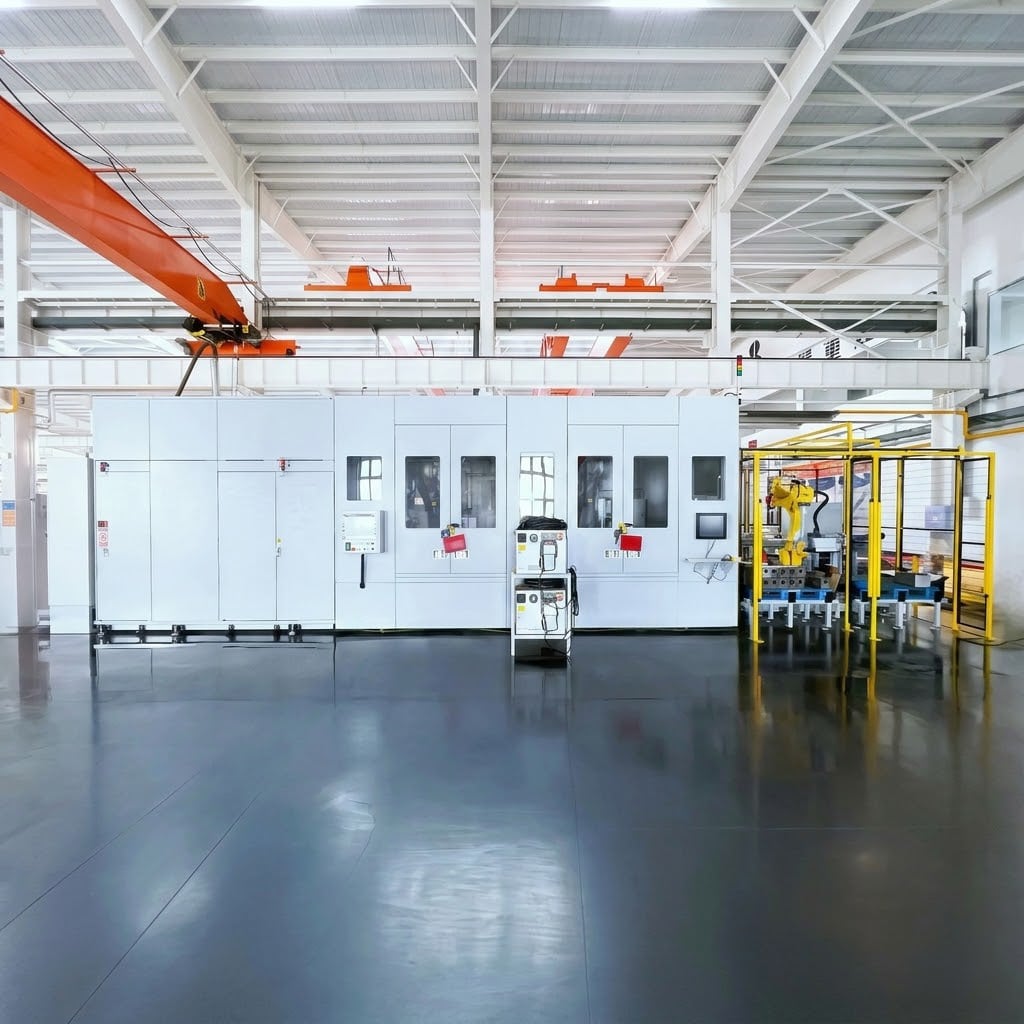
Heavy-Duty Diesel Engine Cylinder Head Robotic Cleaning System for Automotive Powertrain Manufacturing
Application: Cylinder Head Intermediate Cleaning for Heavy-Duty Diesel Engine Manufacturing — Multiple Models
Workpiece: Cylinder Head Sub-Assembly for Heavy-Duty Diesel Engine
Cleaning Process: Turbulent Cleaning + Fixed-Point High-Pressure Cleaning (1.5 MPa) + Spray Rinsing (1.0 MPa) + Fixed-Point Blow-Drying + Vacuum Drying + Cooling
Cleaning Pressure: Fixed-Point Cleaning ≥ 1.5 MPa / Spray Rinsing ≥ 1.0 MPa
Cleaning Temperature: 40–60°C (Electric Heating)
Cycle Time: ≤ 18 seconds per piece
Production Capacity: ≥ 228 qualified pieces per 8-hour shift (OEE ≥ 95%)
Cleanliness Requirement: Rocker Arm Oil Gallery ≤ 0.4 mg / Fuel Return Gallery ≤ 1.5 mg / Oil Return Gallery ≤ 7.3 mg / Intake & Exhaust Ports ≤ 14.5 mg / Cooling Jacket ≤ 56 mg / No Residual Adhesive
Drying Technology: Fixed-Point Blow-Drying (0.2–0.4 MPa) + Vacuum Drying + Cooling to Room Temperature ± 5°C
Filtration System: Four-Stage Filtration (50 μm → 30 μm → 10 μm)
Loading/Unloading: Automatic Loading & Unloading
Automation Features: 6-Axis Robots for Handling + 2.5D Vision Inspection + QR Code Recognition + MES Communication + Automatic Model Changeover
Description
Heavy-Duty Diesel Engine Cylinder Head Robotic Cleaning System
The Big Bird Industrial Cylinder Head Robotic Cleaning System is developed for post-machining cleaning of cylinder heads used in heavy-duty diesel engine manufacturing. The system removes machining residues before final assembly and supports full automatic mixed-model production without manual changeover.
The equipment is provided as a turnkey solution including design, manufacturing, installation, and commissioning.
Workpiece Applications
The system accommodates multiple cylinder head variants for mixed-model production:
| Variant | Weight |
|---|---|
| Variant A | 16.4 kg |
| Variant B | 16.6 kg |
| Variant C | 16.4 kg |
| Variant D | 15.8 kg |
| Variant E | 15.9 kg |
| Variant F | 15.8 kg |
All workpieces are cylinder head sub-assemblies for heavy-duty diesel engine applications.
Automatic Mixed-Model Production
The system supports fully automatic mixed-model production with the following capabilities:
QR Code Recognition
QR code scanning devices automatically read workpiece identification upon loading. The system selects the appropriate cleaning program based on the QR code information. Storage capacity supports up to 256 part number variants.
2.5D Vision Inspection
A 2.5D vision system (2D camera + laser rangefinder, COGNEX) automatically identifies workpiece position and orientation, enabling the robot to adjust gripping accordingly.
NG/OK Parts Sorting
The system automatically identifies unqualified workpieces at the loading station, diverts them to a rejection conveyor, and robotically stacks them for removal. The workpiece production status is updated via MES interface.
Automatic Model Changeover
Fixtures, nozzles, and positioning components are designed to accommodate all cylinder head variants without manual intervention.
Multi-Stage Cleaning Process
The system combines multiple cleaning technologies in an efficient production sequence:
Stage 1: Turbulent Cleaning + Fixed-Point High-Pressure Cleaning (1.5 MPa)
The 6-axis robot transfers the cylinder head into the cleaning tank where water has been pre-filled. The robot flexibly changes workpiece orientation while nozzles perform turbulent cleaning.
After turbulent cleaning, the tank drain valve opens for rapid drainage. The robot positions each workpiece surface to align with corresponding nozzle boxes for fixed-point cleaning, with focused cleaning on all holes and oil galleries.
Stage 2: Spray Rinsing (1.0 MPa)
The robot transfers the workpiece to the rinsing station with an independent tank and filtration system. Surrounding nozzles perform comprehensive spray rinsing of the entire component.
Stage 3: Fixed-Point Blow-Drying (0.2–0.4 MPa)
During transfer to this station, the robot tilts the workpiece for drain-off. The robot then positions each surface to align with nozzle boxes for fixed-point and scanning blow-drying of all holes and passages.
Stage 4: Secondary Blow-Drying (0.2–0.4 MPa)
A nozzle box descends from above to perform secondary fixed-point and scanning blow-drying, ensuring complete moisture removal.
Stage 5: Vacuum Drying
The workpiece enters the vacuum chamber. The upper movable hood closes with the bottom fixed hood to form a sealed chamber. The vacuum pump reduces chamber pressure, lowering the saturated steam temperature to evaporate residual moisture from component surfaces.
Stage 6: Cooling
The workpiece is cooled to room temperature ±5°C before exiting the system, ensuring safe handling for downstream assembly operations.
Technical Cleanliness Control
For modern engine manufacturing, cleanliness of internal passages directly affects engine reliability and performance.
The system is designed to meet strict cleanliness requirements for each cylinder head passage:
| Area | Cleanliness Limit | Particle Size | Pass Rate |
|---|---|---|---|
| Rocker Arm Oil Gallery | ≤ 0.4 mg | 0.36 mm | 80% |
| Fuel Return Gallery | ≤ 1.5 mg | ≤ 0.6 mm | 80% |
| Oil Return Gallery | ≤ 7.3 mg | ≤ 0.6 mm | 80% |
| Intake & Exhaust Ports | ≤ 14.5 mg | ≤ 0.6 mm | 80% |
| Cooling Jacket | ≤ 56 mg | 1 mm | 80% |
| Water Cavity Bowl Plug Area | No residual adhesive | — | Endoscope inspection |
| Push Rod Bushing Area | No residual adhesive | — | Endoscope inspection |
Advanced Filtration Management
The system employs an independent four-stage filtration system for cleaning and rinsing circuits:
Cleaning Circuit Filtration:
Stage 1: Drum filter — 1,500 L/min, 50 μm, stainless steel mesh
Stage 2: Cyclone separator — 1,400 L/min
Stage 3: Automatic back-flush filter — 1,330 L/min, 30 μm, with automatic back-flush and independent magnetic separator for back-flush fluid
Stage 4: Bag filter — 1,500 L/min, 10 μm, with pressure switch auto-alarm, one active + one standby for non-stop bag change
Rinsing Circuit Filtration:
Stage 4: Bag filter — 300 L/min, 10 μm, with pressure switch auto-alarm
Robot System
The system utilizes multiple FANUC robots:
| Robot | Model | Application | Payload | Protection | Reach |
|---|---|---|---|---|---|
| Robot A (Cleaning) | R-2000iC/210WE | Workpiece handling in cleaning | 210 kg | IP67 | 2.45 m |
| Robot B (Cleaning) | R-2000iC/210WE | Workpiece handling in cleaning | 210 kg | IP67 | 2.45 m |
| Robot C (Loading) | R-2000iC/165F | Loading/Unloading & sorting | 165 kg | IP67 | 2.655 m |
All robots are IP67 protected for high-temperature, high-pressure cleaning environments. Robot grippers feature pneumatic self-locking (parts clamp on pressure loss) and air seal protection against moisture ingress. A 20% safety load margin is reserved.
Intelligent Manufacturing Integration
The system supports Industry 4.0 requirements through comprehensive data connectivity:
MES Communication
OPC UA protocol support
QR code-based workpiece tracking
Production status updates
Data Acquisition
Equipment fault monitoring (time, frequency)
Production count and cycle time recording
Equipment uptime tracking
Electrical cabinet temperature and humidity
Power consumption monitoring (SIEMENS smart meter)
Operator Management
Three-level access control (operator, maintenance, supervisor)
Operator login/logout with shift recording
Traceability
QR code scanning at loading
Workpiece production status tracking via MES
Combined barcode generation for pallet management
Application Case
| Parameter | Specification |
|---|---|
| Project | Weichai Power QGY Line Cylinder Head Cleaning System |
| Workpiece | WP12 / WP17 / WP13F / WP13VG / WP13 / WP17F Cylinder Heads |
| Cycle Time | ≤ 18 seconds per piece (36s/2 pieces) |
| Production Capacity | ≥ 228 qualified pieces / 8-hour shift |
| OEE | ≥ 95% |
| Cleaning Technologies | Turbulent + Fixed-Point 1.5 MPa + Rinsing 1.0 MPa + Vacuum Drying |
| Cleaning Temperature | 40–60°C |
| Drying Method | Blow-Drying + Vacuum Drying + Cooling |
| Filtration Accuracy | Four-Stage: 50 μm → 30 μm → 10 μm |
| Total Power | 112 kW (plus 120 kW heaters) |
| Noise Level | ≤ 70 dB (under load) |
| Footprint | 16,000 × 4,500 mm (L × W) |
Complete Cleaning Solution
Big Bird Industrial provides comprehensive engineering solutions including:
Process Development
Component analysis
Cleaning process design
Cleanliness requirement evaluation
Equipment Integration
Robotic cleaning stations
High-pressure cleaning systems
Vacuum drying technology
Automated material handling
Multi-stage filtration management
Smart Manufacturing Connection
MES interface (OPC UA)
QR code traceability
Production data acquisition
IIoT integration
Why Choose Big Bird Industrial
Heavy-Duty Engine Component Experience
Big Bird Industrial specializes in precision cleaning solutions for automotive powertrain components, with proven experience in cylinder head cleaning for heavy-duty diesel engine applications.
High-Volume Production Solutions
The system delivers rapid cycle times of 18 seconds per piece with OEE ≥ 95%, supporting continuous 24/7 production with automatic mixed-model changeover for multiple cylinder head variants.
System-Level Engineering Capability
The company provides complete solutions from cleaning process development to production integration, including robotic handling, high-pressure cleaning, vacuum drying, intelligent traceability, and MES connectivity.
Customized Non-Standard Engineering
Each component and production line has unique requirements. Big Bird Industrial provides customized engineering solutions based on:
Component structure and material analysis
Cleaning process development
Customized fixture and automation design
Factory layout and production flow integration
The company's non-standard engineering capability allows each cleaning system to be tailored to specific component geometry, cycle time requirements, cleanliness standards, and automation level—delivering solutions that standard equipment cannot provide.
Technical Cleanliness Expertise
Modern engine manufacturing requires controlled cleanliness of internal passages—not just surface cleaning. Big Bird Industrial develops solutions focused on residual particle control, oil gallery cleanliness, process stability, and production traceability.
Compliance with Standards
All equipment complies with ISO 13849, IEC 62061 (SIL3), GB 5226.1, and applicable Chinese and international safety standards. Pressure vessels are certified by third-party inspection authorities.
FAQ
What components does this cleaning system process?
This system is designed for cylinder head sub-assemblies for heavy-duty diesel engine models.
What contaminants can be removed?
It removes metal chips, machining particles, cutting fluid residues, adhesive residues, and internal contamination from oil galleries, fuel passages, intake/exhaust ports, and cooling jackets.
Can it clean internal oil galleries and passages?
Yes. The system combines turbulent cleaning, fixed-point high-pressure cleaning (1.5 MPa), and vacuum drying to reach all internal passages including rocker arm oil galleries, fuel return galleries, oil return galleries, intake/exhaust ports, and cooling water jackets.
What cleanliness levels can be achieved?
Rocker arm oil gallery ≤ 0.4 mg; fuel return gallery ≤ 1.5 mg; oil return gallery ≤ 7.3 mg; intake/exhaust ports ≤ 14.5 mg; cooling jacket ≤ 56 mg. No residual adhesive in bowl plug or push rod bushing areas.
Does it support automated mixed-model production?
Yes. The system handles multiple cylinder head variants automatically. QR code recognition selects the appropriate cleaning program. Fixtures and nozzles are designed for all variants. No manual changeover is required.
What cycle time can be expected?
The system delivers ≤ 18 seconds per piece (36s/2 pieces), supporting production of ≥ 228 qualified pieces per 8-hour shift.
Does it support MES integration?
Yes. OPC UA communication, QR code traceability, production data acquisition, and MES interface are fully supported.
Cylinder Head Cleaning in Heavy-Duty Diesel Engine Manufactu
Cylinder Head Cleaning in Heavy-Duty Diesel Engine Manufacturing
Cylinder head cleaning is a critical process between machining and assembly in heavy-duty diesel engine manufacturing. The complex geometry of cylinder heads—including multiple oil galleries, fuel passages, intake/exhaust ports, and cooling water jackets—requires advanced cleaning technologies to remove machining residues, metal chips, and cutting fluid contaminants. Modern engine manufacturers demand strict cleanliness levels for internal passages to ensure reliable engine performance, fuel efficiency, and emissions compliance.
Robotic Flexible Cleaning for Mixed-Model Engine Production
With the increasing variety of engine models in modern manufacturing, robotic flexible cleaning systems have become essential for efficient production. Six-axis robots enable adaptive cleaning through flexible workpiece positioning and multi-angle nozzle targeting. Combined with QR code recognition and vision inspection, these systems support fully automatic mixed-model production without manual changeover—delivering consistent cleaning quality across multiple workpiece variants.
High-Volume Cleaning Solutions for Automotive Powertrain
Automotive powertrain component cleaning requires balancing cleaning quality with high production throughput. Modern high-volume cleaning solutions combine turbulent cleaning, fixed-point high-pressure cleaning, spray rinsing, and vacuum drying in a compact production sequence to achieve cycle times of 18 seconds per piece while maintaining strict cleanliness requirements. OEE of 95% and above ensures continuous 24/7 production capability.
Filtration Technology in Industrial Parts Cleaning
Effective filtration systems are fundamental to maintaining consistent cleaning quality in industrial parts cleaning. Four-stage filtration configurations—combining drum filters, cyclone separators, automatic back-flush filters, and bag filters—enable continuous operation with non-stop filter changes. Filtration accuracy down to 10 μm ensures cleaning fluid quality is maintained, reducing recontamination risks and extending fluid life.
Technical Specifications
| Specification | Description |
|---|---|
| Product Type | Cylinder Head Robotic Cleaning System |
| Application | Heavy-Duty Diesel Engine Cylinder Head Cleaning |
| Workpiece | Multiple Cylinder Head Variants for Heavy-Duty Diesel Engines |
| Cleaning Technology | Turbulent + Fixed-Point High-Pressure (1.5 MPa) + Spray Rinsing (1.0 MPa) |
| Cleaning Temperature | 40–60°C (Electric Heating) |
| Drying Technology | Blow-Drying (0.2–0.4 MPa) + Vacuum Drying + Cooling |
| Cooling Result | Room Temperature ±5°C |
| Cycle Time | ≤ 18 seconds per piece |
| Production Capacity | ≥ 228 qualified pieces / 8-hour shift |
| OEE | ≥ 95% |
| Filtration System | Four-Stage: 50 μm → 30 μm → 10 μm |
| Robot Models | FANUC R-2000iC/210WE (2 pcs) + R-2000iC/165F (1 pc) |
| Robot Protection | IP67 |
| Loading/Unloading | Automatic |
| Control System | SIEMENS S7-1500 PLC |
| Communication Protocol | PROFINET, OPC UA |
| Power Supply | AC 380V 50Hz Three-Phase |
| Total Power | 112 kW (plus 120 kW heaters) |
| Compressed Air | 8 Nm³/min |
| Water Consumption | 4,000 L (Total Tank Capacity) |
| Noise Level | ≤ 70 dB (under load) |
| Safety Standards | GB/T 15706, IEC 62061 (SIL3), GB 5226.1 |
| Electrical Cabinet | RITTAL, IP54 with Air Conditioning |