EN
EN



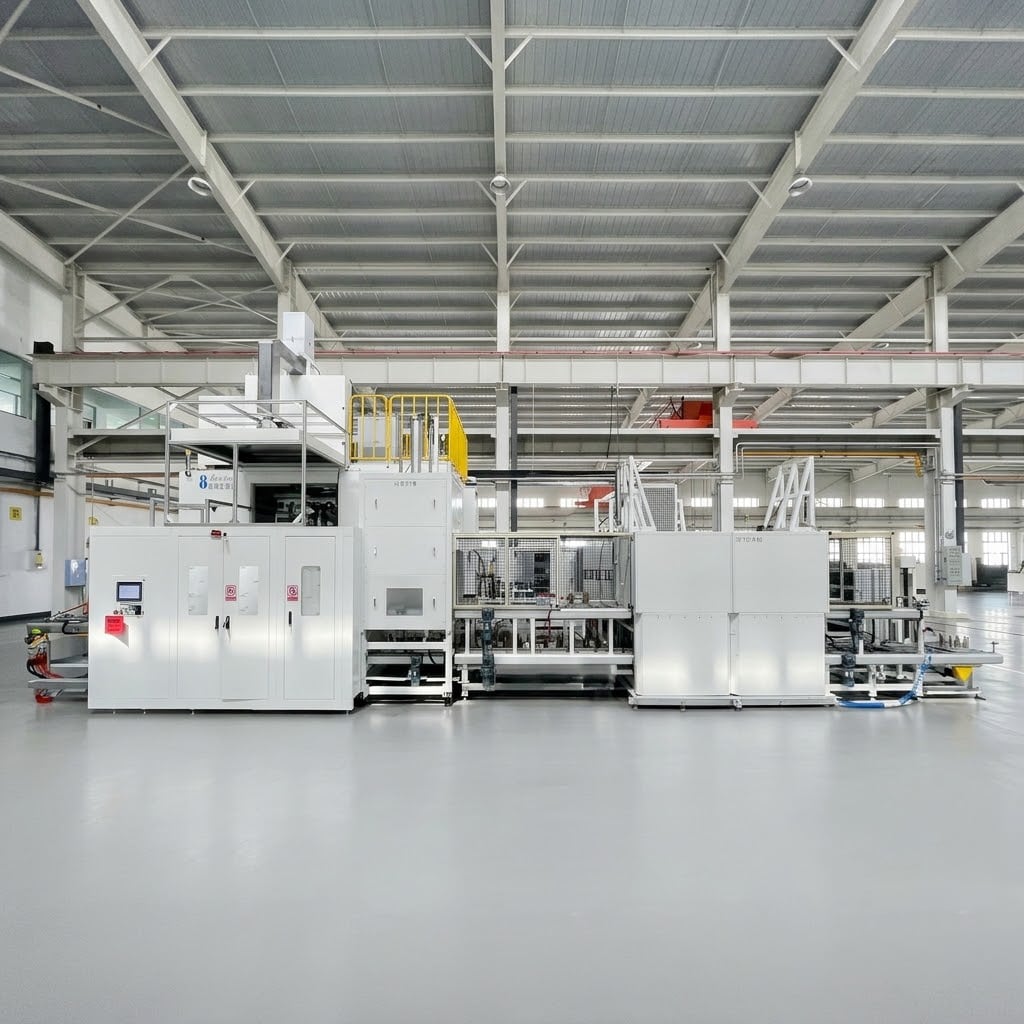
Commercial Vehicle Transmission Retarder Stator/Rotor High-Pressure Cleaning System for Heavy-Duty Powertrain Manufacturing
Customized turnkey solution for a major commercial vehicle transmission manufacturer
Application: Transmission Retarder Stator/Rotor Cleaning for Heavy-Duty Commercial Vehicle Powertrain Manufacturing
Workpiece: Stator/Rotor Components for Transmission Retarder Systems — Multiple Variants (2.43–10.5 kg)
Cleaning Process: Turbulent Cleaning (1.0 MPa) + High-Pressure Fixed-Point Cleaning (35 MPa) + Spray Rinsing + Immersion Turbulent Rinsing + Vacuum Drying (≤10 mbar) + Cooling
Cleaning Pressure: High-Pressure ≥35 MPa (Max Adjustable 50 MPa) / Turbulent 1.0 MPa — customizable
Cleaning Temperature: 35–45°C (Electric Heating, Room Temperature to 50°C) — customizable
Cycle Time: ≤2 minutes per piece — customizable per production line requirements
Cleanliness Requirement: Residual Contamination ≤0.55 mg/kg; Metal Particles ≤600 μm; Non-Metal Particles ≤1200 μm — customizable per customer requirements
Drying Technology: Vacuum Drying (≤10 mbar) + Cooling to Room Temperature ±3°C
Filtration System: Three-Stage Filtration (50 μm / 10 μm / 5 μm) — customizable
Robot Configuration: 6-Axis Robot (IP67) — customizable
Loading/Unloading: Manual (with automatic integration capability) — customizable
Description
Commercial Vehicle Transmission Retarder Stator/Rotor High-Pressure Cleaning System
The Big Bird Industrial Stator/Rotor High-Pressure Cleaning System is developed for post-machining cleaning of stator and rotor components used in commercial vehicle transmission retarder systems. The system removes machining chips, graphite particles, iron powder, and cutting fluid residues before final assembly and supports mixed-model production for multiple workpiece variants.
The equipment is provided as a turnkey solution including design, manufacturing, installation, and commissioning.
Workpiece Applications
The system accommodates multiple stator/rotor variants for transmission retarder applications:
| Category | Material | Weight Range |
|---|---|---|
| Stator/Rotor Components (12 Variants) | Ductile Iron / Gray Iron | 2.43–10.5 kg |
All workpieces are transmission retarder stator and rotor components for heavy-duty commercial vehicle applications. The system is designed to accommodate parts within 700 × 600 × 600 mm dimensions and up to 80 kg weight.
Automatic Mixed-Model Production
The system supports automatic mixed-model production with:
QR Code Recognition
A COGNEX QR code scanning device automatically reads workpiece identification upon loading. The scanner is horizontally adjustable for flexible positioning.
Vision Inspection System
A COGNEX vision system with camera inspection confirms workpiece type and orientation upon loading, ensuring correct program selection.
Manual Pallet Changeover
Two pallet types accommodate all 12 workpiece variants. Changeover is performed manually between part families (stator vs. rotor) using a quick-change pallet system.
Error-Proofing
Workpiece presence detection and orientation verification prevent loading errors and ensure process integrity.
Multi-Stage Cleaning Process
The system combines multiple cleaning technologies in a 6-stage automated sequence:
Stage 1: Loading (1ST)
The operator places the workpiece onto the locating pallet on the loading roller conveyor. The conveyor transports the workpiece to the robot pick-up position. The robot grips the workpiece and transfers it into the cleaning chamber.
After the robot removes the workpiece, the empty pallet is returned to the loading position, ready for the next workpiece. This station features workpiece orientation detection, presence detection, QR code scanning, and vision inspection for part identification. Two pallet types accommodate all workpieces with manual changeover between stator and rotor variants.
Stage 2: Turbulent & Fixed-Point Cleaning (2ST) — 1.0 MPa
The 6-axis robot holds the workpiece and transfers it into the turbulent cleaning tank, which has been pre-filled with cleaning fluid. The robot flexibly changes workpiece orientation while surrounding nozzles direct turbulent flow to clean all surfaces.
After turbulent cleaning, the drain valve opens to rapidly drain the tank (drain time ≤5 seconds). The robot positions the workpiece at fixed nozzle boxes arranged according to the workpiece hole patterns. The robot changes workpiece orientation to align each surface with corresponding nozzle panels, ensuring all holes and internal cavities receive targeted cleaning.
Two nozzle box panels accommodate large and small workpiece families, with manual changeover between them. After cleaning, the robot transfers the workpiece to the next station. The cleaning pump continues filling the turbulent tank so it is ready for the next workpiece.
Stage 3: High-Pressure Cleaning (3ST) — ≥35 MPa (Max Adjustable 50 MPa)
The robot transfers the workpiece to the high-pressure cleaning station. The robot changes workpiece orientation to align with high-pressure fixed-point nozzles, performing high-pressure cleaning on critical areas including blind holes and internal cavities.
This station features linear nozzles and 90° angle nozzles for comprehensive coverage. Additional high-pressure rotating nozzles (spray curtain diameter ≥60 mm) provide scanning cleaning across workpiece surfaces.
After high-pressure cleaning, the robot transfers the workpiece to the next station with tilt-drainage during transfer.
Stage 4: Comprehensive Rinsing (4ST) — Spray Rinsing + Immersion Turbulent Rinsing + High-Efficiency Drying
The robot places the workpiece onto the positioning pallet within this station. Clamping mechanisms secure the workpiece in position.
A movable water tank extends to enclose the workpiece with the fixed cleaning tank. Fixed-point nozzles perform spray rinsing on the workpiece. Simultaneously, water gradually fills the tank, immersing the workpiece in cleaning fluid and creating turbulent flow for thorough internal and external rinsing.
After the two-stage rinsing process, high-efficiency drying removes surface moisture from the workpiece. This drying process does not use compressed air. After rinsing, the movable water tank opens, clamps release, and the robot transfers the workpiece to the outlet conveyor pallet.
To extend rinsing time, this station features two positions. The robot places the workpiece in one position while retrieving a previously rinsed workpiece from the other position. Fixed blow-drying nozzles provide supplementary drying as needed.
This station features an independent water tank, pump, and filtration system operating at ambient temperature. Two pallet types accommodate stator and rotor variants with manual changeover.
Stage 5: Vacuum Drying (5ST) — ≤10 mbar
The workpiece and pallet are conveyed into the vacuum chamber. The upper movable vacuum hood extends via cylinder actuation to form a sealed chamber with the bottom fixed hood.
The vacuum pump evacuates the chamber, reducing pressure to as low as 10 mbar. This lowers the saturated steam temperature, evaporating residual moisture from all surfaces and internal cavities.
After vacuum drying, the chamber is vented, the movable hood returns to its original position, and the conveyor transports the workpiece to the next station.
Stage 6: Cooling & Unloading (6ST)
The workpiece is conveyed into the cooling channel. Forced air cooling and fans reduce the component temperature to room temperature ±3°C. The cooling channel accommodates up to 10 workpieces in queue. The system measures three or more positions on each workpiece to ensure temperature uniformity (maximum-to-minimum temperature difference ≤1°C) and consistent temperature across consecutive workpieces (temperature variation ≤3°C between workpieces).
After cooling, the workpiece and pallet are conveyed to the unloading position. The operator removes the workpiece. Empty pallets are returned to the loading position via the lower-layer conveyor for pallet circulation. This station features workpiece presence detection, room temperature monitoring, and workpiece surface temperature monitoring.
High-Pressure Cleaning Technology
The system features a high-pressure cleaning system with exceptional capability:
| Parameter | Specification |
|---|---|
| Cleaning Pressure | ≥35 MPa (Max Adjustable 50 MPa) |
| High-Pressure Pump | Hammerlmann with VFD control |
| Motor Power | 110 kW |
| Key Feature | Pressure is adjustable via variable frequency drive — Maximum 50 MPa |
This high-pressure capability enables effective removal of stubborn machining chips, graphite particles, and iron powder from blind holes and complex internal cavities that conventional cleaning cannot reach.
Vacuum Drying Technology
The system features advanced vacuum drying for thorough moisture removal:
| Parameter | Specification |
|---|---|
| Vacuum Level | ≤10 mbar |
| Result | Complete dryness — no visible moisture, water droplets, or water mist on any surface, blind hole, or internal cavity |
Vacuum drying ensures components are completely dry for downstream operations without the risk of water spots or corrosion.
Technical Cleanliness Control
For commercial vehicle transmission retarder manufacturing, cleanliness of stator and rotor components directly affects retarder performance and reliability.
The system is designed to meet strict cleanliness requirements:
| Requirement | Specification |
|---|---|
| Total Residual Contamination | ≤0.55 mg/kg |
| Maximum Metal Particle Size | ≤600 μm |
| Maximum Non-Metal Particle Size | ≤1200 μm |
| Inspection Method | White tissue paper wipe — 5 wipes, no contamination or discoloration |
| Drying Verification | Workpiece inverted — no visible water droplets |
Advanced Filtration Management
The system employs a three-stage (or higher) filtration system:
| Filter Type | Capacity | Accuracy | Application |
|---|---|---|---|
| Drum Filter | 1,500 L/min | 50 μm | Primary cleaning filtration with auto-backflush |
| Bag Filter | 300 L/min | 10 μm | Secondary cleaning filtration (1 standby + 3 active) |
| In-Line Bag Filter | 200 L/min | 5 μm | High-pressure pump tertiary filtration (1 standby + 1 active) |
| Drum Filter | 300 L/min | 40 mesh | Primary rinsing filtration |
| Bag Filter | 300 L/min | 5 μm | Secondary rinsing filtration (1 standby + 2 active) |
Filtration Features:
Filter blockage alarm displayed on HMI
Non-stop filter change capability (bag change ≥15 days; high-pressure filter change ≥30 days)
Differential pressure monitoring to detect bag damage or blockage
Filter bags: 180 × 810 mm size
Easy cleaning and replacement access
Oil Separation System
The system features comprehensive oil separation capability:
Configuration: 2 float-type oil skimmers + 1 belt-type oil skimmer
Oil Skimmer Replacement Cycle: ≥2 years
Surface Oil Coverage: <10% of liquid surface area
Oil Removal Rate: ≥99%
Float Reliability: Stable operation ≥3 months with accurate liquid level following
Intelligent Manufacturing Integration
The system supports Industry 4.0 requirements through comprehensive data connectivity:
MES Communication
Siemens S7-1500 PLC with PROFINET
Two independent Ethernet ports with separate IP addresses
OPC UA communication for data acquisition
Remote diagnostic capability for online troubleshooting
Operator Interface
Siemens TP1200 touch screen (12" minimum)
Chinese/English language switching
Workpiece information display
Cleaning program selection
Cleaning progress monitoring
Temperature and pressure display
Fault diagnosis and alarm display with troubleshooting guidance
Tank liquid level monitoring and alarm
Data Acquisition
Equipment fault monitoring (time, frequency)
Production count and cycle time recording
Equipment uptime tracking
Power consumption monitoring (SIEMENS smart meter)
Water and air consumption monitoring
Application Case
| Parameter | Specification |
|---|---|
| Project | Major Commercial Vehicle Transmission Manufacturer — Stator/Rotor High-Pressure Cleaning System |
| Workpiece | Stator/Rotor Components for Transmission Retarder Systems (12 Variants, 2.43–10.5 kg) |
| Cycle Time | ≤2 minutes per piece |
| Cleaning Technologies | Turbulent 1.0 MPa + HP Fixed-Point 35 MPa (Max 50 MPa) + Rinsing + Vacuum Drying ≤10 mbar |
| Cleaning Temperature | 35–45°C |
| Drying Method | Vacuum Drying + Cooling |
| Cooling Result | Room Temperature ±3°C |
| Robot | FANUC R-2000iC/210WE, IP67 |
| Control System | Siemens S7-1500 PLC |
| Filtration Accuracy | 50 μm / 10 μm / 5 μm |
| Total Power | 295 kW (including 120 kW heaters) |
| Vacuum Level | ≤10 mbar |
Complete Cleaning Solution
Big Bird Industrial provides comprehensive engineering solutions including:
Process Development
Component analysis for stator/rotor components
Cleaning process design for transmission retarder parts
Cleanliness requirement evaluation
Equipment Integration
High-pressure cleaning systems (35 MPa, max 50 MPa)
Turbulent cleaning technology
Vacuum drying systems
Multi-stage filtration management
Conveyor and material handling systems
Smart Manufacturing Connection
MES interface (OPC UA)
QR code traceability
Production data acquisition
Why Choose Big Bird Industrial
Transmission Component Experience
Big Bird Industrial specializes in precision cleaning solutions for automotive and commercial vehicle powertrain components, with proven experience in stator and rotor cleaning for transmission retarder systems.
High-Pressure Cleaning Technology
The system delivers high-pressure cleaning up to 35 MPa (max adjustable 50 MPa) — significantly higher than conventional cleaning systems — ensuring effective removal of stubborn contaminants from blind holes and complex internal cavities.
Vacuum Drying Technology
The system achieves vacuum levels as low as 10 mbar for complete moisture removal from all surfaces, blind holes, and internal cavities — eliminating the risk of water spots or corrosion.
System-Level Engineering Capability
The company provides complete solutions from cleaning process development to production integration, including high-pressure cleaning, vacuum drying, intelligent traceability, and MES connectivity.
Customized Non-Standard Engineering
Each component and production line has unique requirements. Big Bird Industrial provides customized engineering solutions based on:
Component structure and material analysis
Cleaning process development
Customized fixture and automation design
Factory layout and production flow integration
The company's non-standard engineering capability allows each cleaning system to be tailored to specific component geometry, cycle time requirements, cleanliness standards, and automation level.
Mixed-Model Production Support
The system handles 12 workpiece variants with pallet changeover and QR code recognition, supporting flexible production for multiple part families.
FAQ
What components does this cleaning system process?
This system is designed for stator and rotor components used in commercial vehicle transmission retarder systems — 12 variants in ductile iron and gray iron, weighing 2.43–10.5 kg.
What cleaning pressure is available?
The system delivers high-pressure cleaning up to 35 MPa (minimum), with maximum adjustable pressure of 50 MPa via VFD control.
What vacuum level is achieved for drying?
The system achieves vacuum levels as low as 10 mbar for complete moisture removal from all surfaces and internal cavities.
What contaminants can be removed?
It removes metal chips, graphite particles, iron powder, cutting fluid residues, and oil contamination from surfaces, blind holes, and internal cavities.
What cleanliness levels can be achieved?
Total residual contamination ≤0.55 mg/kg; metal particles ≤600 μm; non-metal particles ≤1200 μm. Surface cleanliness verified by white tissue paper wipe (5 wipes, no discoloration).
Is the system customizable?
Yes. All parameters—including cycle time, cleaning pressure, temperature, and automation level—are customizable per customer production line requirements.
What is the typical cycle time?
The system delivers ≤2 minutes per piece, supporting high-volume production for commercial vehicle powertrain manufacturing.
Stator/Rotor Cleaning in Commercial Vehicle Transmission Man
Stator/Rotor Cleaning in Commercial Vehicle Transmission Manufacturing
Stator and rotor components in transmission retarder systems require precise cleaning to ensure reliable performance. These precision components with complex geometries—including blind holes, internal cavities, and fine surface finishes—demand advanced cleaning technologies to remove metal chips, graphite particles, and machining residues. High-pressure cleaning systems deliver the cleaning power necessary for thorough contaminant removal from these critical components.
High-Pressure Cleaning (35 MPa) for Precision Powertrain Components
High-pressure cleaning at 35 MPa (max adjustable 50 MPa) provides superior contaminant removal for precision transmission components. The extreme pressure effectively dislodges stubborn particles from blind holes, internal cavities, and complex geometries that conventional low-pressure cleaning cannot reach. Variable frequency drive control allows pressure adjustment for different component requirements and contamination levels.
Vacuum Drying Technology (≤10 mbar) for Component Protection
Vacuum drying at ≤10 mbar ensures complete moisture removal from all surfaces and internal cavities without thermal stress or water spots. This low-pressure environment lowers the saturated steam temperature, evaporating residual moisture efficiently. The result is thoroughly dry components ready for downstream operations, eliminating the risk of corrosion, water spots, or contamination from moisture.
Filtration and Fluid Management in High-Pressure Cleaning
Effective filtration is essential for maintaining cleaning quality in high-pressure cleaning systems. Three-stage filtration configurations with drum filters, bag filters, and in-line filters protect high-pressure pumps from damage while maintaining cleaning fluid cleanliness. Non-stop filter change capability ensures continuous operation without production interruptions. Filtration accuracy down to 5 μm ensures cleaning fluid quality is maintained for consistent cleaning results.
Specification Details
| Specification | Description |
|---|---|
| Product Type | Stator/Rotor High-Pressure Cleaning System |
| Application | Commercial Vehicle Transmission Retarder Component Cleaning |
| Workpiece | Stator/Rotor Components (12 Variants, 2.43–10.5 kg) |
| Cleaning Technology | Turbulent (1.0 MPa) + HP Fixed-Point (35 MPa, Max 50 MPa) + Spray Rinsing + Immersion Turbulent Rinsing + Vacuum Drying |
| Cleaning Temperature | 35–45°C (Electric Heating, Room Temperature to 50°C) |
| Drying Technology | Vacuum Drying (≤10 mbar) + Cooling |
| Cooling Result | Room Temperature ±3°C |
| Cycle Time | ≤2 minutes per piece (customizable) |
| Robot Model | FANUC R-2000iC/210WE |
| Robot Protection | IP67 |
| Robot Reach | 2.45 m |
| Control System | Siemens S7-1500 PLC |
| HMI | Siemens TP1200 Touch Screen |
| Communication Protocol | PROFINET, OPC UA |
| Filtration System | Three-Stage: 50 μm / 10 μm / 5 μm |
| High-Pressure Pump | Hammerlmann with VFD, 110 kW |
| Total Power | 295 kW (including 120 kW heaters) |
| Compressed Air | 2 Nm³/min |
| Water Consumption | 4,500 L (Total Tank Capacity) |
| Noise Level | ≤80 dB (at 1 meter, per GB/T16769-2008) |
| Footprint | 10,000 × 7,500 × 5,500 mm |
| Safety Standards | GB/T 30574-2014, GB/T 12801-2008, GB/T 33000-2016 |