EN
EN



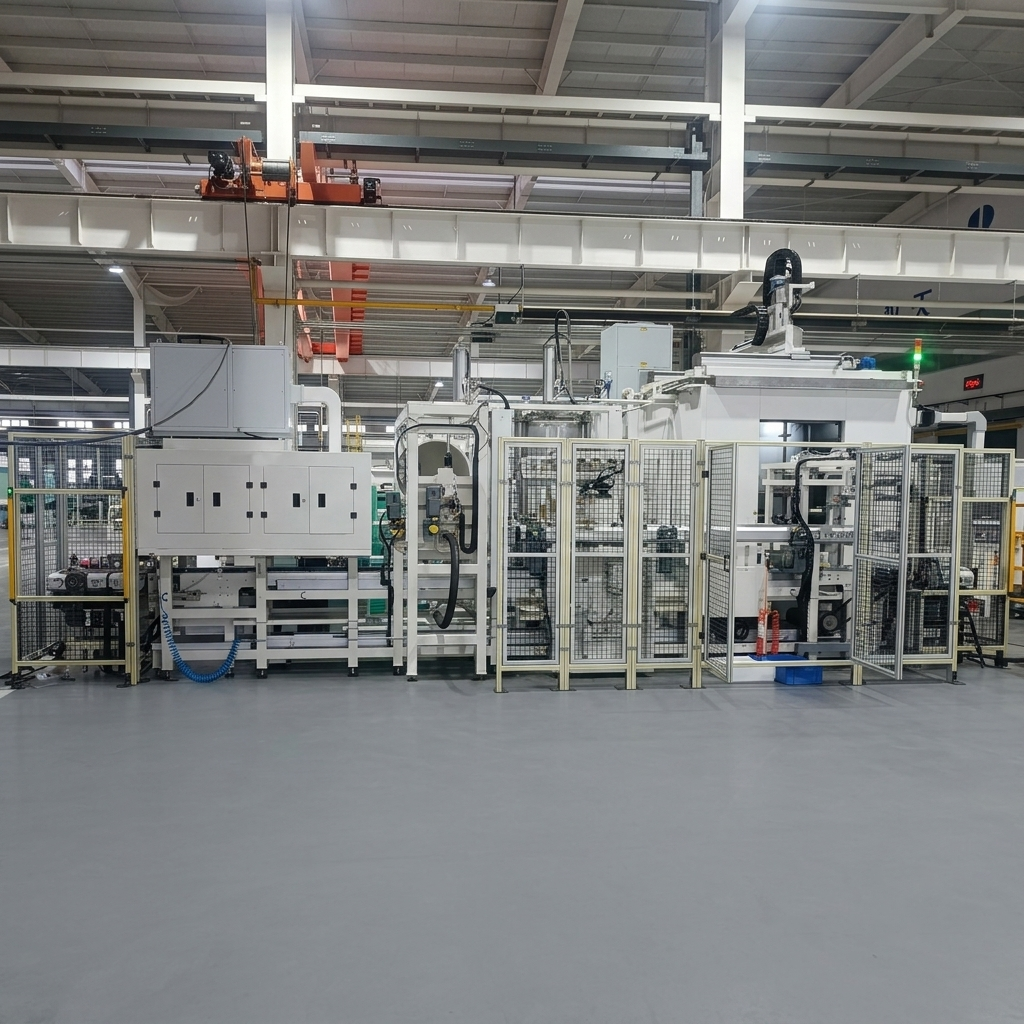
Automotive Aluminum Transmission Housing High-Pressure Cleaning System for Powertrain Component Manufacturing
Customized solution for a major automotive transmission component manufacturer
Application: Aluminum Transmission Housing Intermediate Cleaning for Automotive Powertrain Manufacturing
Workpiece: Aluminum Transmission Housing / Powertrain Housing (Multiple Variants)
Cleaning Process: High-Pressure Fixed-Point Cleaning (4 MPa) + Spray Cleaning (0.5 MPa) + Immersion Turbulent Rinsing + Spray Rinsing (1.0 MPa) + Vacuum Drying + Cooling
Cleaning Pressure: 4 MPa (High-Pressure) / 0.5 MPa (Spray) / 1.0 MPa (Rinsing) — customizable
Cleaning Temperature: 40–60°C (Electric Heating) — customizable
Cycle Time: ≤ 2 minutes per piece — customizable per production line requirements
Cleanliness Requirement: Total Residual Contamination ≤ 3 mg / ≤ 4.12 mg / ≤ 15 mg (per variant); Particle Size < 400–600 μm depending on specification — customizable per customer requirements
Drying Technology: Vacuum Drying + Forced Air Drying + Cooling to Room Temperature ±5°C
Filtration System: Two-Stage Filtration (40 Mesh + 20 μm / 10 μm) — customizable
Loading/Unloading: Manual Loading & Unloading
Description
Automotive Aluminum Transmission Housing High-Pressure Cleaning System
The Big Bird Industrial Aluminum Transmission Housing Cleaning System is developed for post-machining cleaning of automotive transmission housings and powertrain components.
The system removes machining residues before subsequent inspection and assembly processes and supports mixed-model production with manual loading and unloading.
The equipment is provided as a turnkey solution including design, manufacturing, installation, and commissioning.
Workpiece Applications
The system accommodates multiple aluminum housing variants for mixed-model production:
| Variant | Material | Cleaning Requirement |
|---|---|---|
| Variant A | Aluminum Alloy | Total residue ≤ 3 mg / Particles < 400 μm |
| Variant B | Aluminum Alloy | Total residue ≤ 4.12 mg / Particles < 600 μm |
| Variant C | Aluminum Alloy | Total residue ≤ 15 mg / Particles < 600 μm |
All workpieces are aluminum alloy components processed after machining operations. The system is designed to handle complex geometries including internal oil passages, cooling channels, and precision machined surfaces.
Multi-Stage Cleaning Process
The system combines multiple cleaning technologies in a six-stage automated sequence:
Stage 1: Loading (1ST)
The operator places the workpiece onto the locating pallet on the loading lifting roller conveyor. After pressing the start button, the motor-driven roller conveyor transports the workpiece to the next station. The workpiece loading orientation is side-standing on the conveyor pallet. The system is equipped with 9 conveyor pallets designed to accommodate all three housing variants. The loading and unloading positions feature lifting roller conveyors, while the remaining conveyors use a double-layer design for pallet circulation.
Stage 2: High-Pressure Cleaning & Spray Cleaning (2ST) — 4 MPa & 0.5 MPa
The motor-driven roller conveyor transports the pallet-mounted workpiece into the tilting basket within this station. Clamping mechanisms secure both the workpiece and pallet.
The tilting basket rotates the workpiece to specified angles while a four-axis module with high-pressure nozzles performs high-pressure cleaning on all surfaces. Simultaneously, fixed spray nozzles rinse the overall component and pallet.
After high-pressure cleaning, the tilting mechanism tilts the workpiece for drain-off, then returns it to the initial position. Clamps release, and the motor-driven roller conveyor transports the workpiece to the next station entrance.
This station is equipped with workpiece orientation detection and workpiece presence detection.
Stage 3: Comprehensive Rinsing (3ST) — Spray Rinsing + Immersion Turbulent Rinsing + High-Efficiency Drying
The motor-driven roller conveyor transports the pallet-mounted workpiece into the positioning device within this station. Clamping mechanisms secure the workpiece in position.
A movable water tank extends to enclose the workpiece with the fixed cleaning tank. Fixed-point nozzles perform spray rinsing on the workpiece. Simultaneously, water gradually fills the tank, immersing the workpiece in cleaning fluid and creating turbulent flow for thorough internal and external rinsing.
After the two-stage rinsing process, high-efficiency drying removes surface moisture from the workpiece. This drying process does not use compressed air.
After rinsing, the movable water tank opens, and the conveyor transports the workpiece to the next station entrance. This station is equipped with workpiece presence detection and features an independent water tank, pump, and filtration system operating at ambient temperature.
Stage 4: Vacuum Drying (4ST)
The motor-driven roller conveyor transports the pallet-mounted workpiece into the vacuum chamber. The movable vacuum hood closes to form a sealed chamber.
A vacuum pump evacuates the chamber, removing residual moisture from internal cavities and blind holes. Top blow nozzles provide targeted blow-drying for upward-facing holes.
After vacuum drying, the vacuum hood opens, and the motor-driven roller conveyor transports the workpiece to the next station.
Stage 5: Cooling (5ST)
The motor-driven roller conveyor transports the workpiece to this station. A forced air cooler reduces the component temperature to room temperature ±5°C at unloading. When ambient temperature is below 15°C, the cooling result is measured at 15–20°C.
Stage 6: Unloading (6ST)
The motor-driven roller conveyor transports the workpiece and pallet to the lifting roller conveyor at this station. The operator removes the workpiece. Empty pallets are returned to the loading position via the lower-layer conveyor. This station is equipped with workpiece presence detection.
Technical Cleanliness Control
For modern transmission and powertrain manufacturing, cleaning quality directly affects assembly reliability and component performance.
The system is designed to meet strict cleanliness requirements for each workpiece variant:
| Variant | Total Residual Contamination | Particle Size Limit |
|---|---|---|
| Variant A | ≤ 3 mg | < 400 μm |
| Variant B | ≤ 4.12 mg | < 600 μm |
| Variant C | ≤ 15 mg | < 600 μm |
Particle size limits and allowable quantities are strictly controlled according to each component specification.
Advanced Filtration Management
The system employs a two-stage filtration system for cleaning and rinsing circuits:
Cleaning Circuit Filtration:
Stage 1: Drum filter — 300 L/min, 40 mesh, nylon mesh
Stage 2: Bag filter — 300 L/min, 20 μm, non-woven fabric (two active, one standby)
Rinsing Circuit Filtration:
Stage 1: Drum filter — 300 L/min, 40 mesh, nylon mesh
Stage 2: Bag filter — 300 L/min, 10 μm, non-woven fabric (one active, one standby)
Intelligent Process Control
The system supports automated production through:
Roller Conveyor Transfer
Motor-driven roller conveyors transport workpieces between stations with precise positioning. Double-layer roller design enables pallet circulation.
Liquid Level Control
Float-type proximity switches monitor and control liquid levels in three independent tanks, with alarms and shutdown functions at preset limits.
Workpiece Presence Detection
Sensors at each station verify workpiece positioning and transfer status.
Oil Separation
Oil skimmer devices remove floating oil from cleaning fluid to extend fluid life.
Mist Collection
Oil mist collectors capture airborne contaminants, maintaining a clean working environment.
Application Case
| Parameter | Specification |
|---|---|
| Project | Major Automotive Transmission Manufacturer — Aluminum Housing Cleaning System |
| Workpiece | Multiple Aluminum Housing Variants for Automotive Transmissions |
| Cycle Time | ≤ 2 minutes per piece |
| Cleaning Technologies | High-Pressure 4 MPa + Spray 0.5 MPa + Rinsing 1.0 MPa + Vacuum Drying |
| Cleaning Temperature | 40–60°C |
| Drying Method | Vacuum + Forced Air + Cooling |
| Filtration Accuracy | 20 μm / 10 μm |
| Total Power | 95 kW (including 45 kW heater) |
| Noise Level | < 85 dB (at 1 meter) |
Complete Cleaning Solution
Big Bird Industrial provides comprehensive engineering solutions including:
Process Development
Component analysis
Cleaning process design
Cleanliness requirement evaluation
Equipment Integration
High-pressure cleaning systems
Spray and rinsing systems
Vacuum drying technology
Automated material handling
Multi-stage filtration management
Smart Manufacturing Connection
MES interface (OPC UA) — optional
Production data acquisition — optional
Why Choose Big Bird Industrial
Automotive Transmission Component Experience
Big Bird Industrial specializes in precision cleaning solutions for automotive powertrain components, with proven experience in transmission housing cleaning for multiple vehicle applications.
Multi-Stage Cleaning Technology
The system combines high-pressure fixed-point cleaning (4 MPa), spray cleaning, immersion turbulent rinsing, and vacuum drying to achieve strict cleanliness requirements for complex aluminum housings.
System-Level Engineering Capability
The company provides complete solutions from cleaning process development to production integration, including high-pressure cleaning, spray rinsing, vacuum drying, and automated material handling.
Customized Non-Standard Engineering
Each component and production line has unique requirements. Big Bird Industrial provides customized engineering solutions based on:
Component structure and material analysis
Cleaning process development
Customized fixture and automation design
Factory layout and production flow integration
The company's non-standard engineering capability allows each cleaning system to be tailored to specific component geometry, cycle time requirements, cleanliness standards, and automation level.
Cleanliness-Oriented Manufacturing Approach
Automotive manufacturers require controlled cleanliness rather than simple surface washing. Big Bird Industrial develops solutions focused on residual particle control, process stability, and production traceability.
FAQ
What components does this cleaning system process?
This system is designed for aluminum transmission housings and powertrain components used in automotive manufacturing.
What contaminants can be removed?
It removes metal chips, machining particles, cutting fluid residues, and internal contamination from complex housing structures.
Can it clean internal cavities and passages?
Yes. The system combines immersion turbulent rinsing and high-pressure fixed-point cleaning to reach internal chambers, oil passages, and cooling channels.
What cleanliness levels can be achieved?
Cleanliness requirements vary by component specification, typically ranging from 3 mg to 15 mg total residual contamination with strict particle size limits.
Is the system customizable?
Yes. All parameters—including cycle time, cleaning pressure, temperature, automation level, and filtration configuration—are customizable per customer production line requirements.
What is the typical cycle time?
The demonstrated cycle time is ≤ 2 minutes per piece, customizable based on production line requirements.
Transmission Housing Cleaning in Automotive Manufacturing
Transmission Housing Cleaning in Automotive Manufacturing
Transmission housing cleaning is a critical process between machining and assembly in automotive powertrain manufacturing. Aluminum housings with complex internal geometries—including oil passages, cooling channels, and precision machined surfaces—require advanced cleaning technologies to remove metal chips, machining particles, and cutting fluid contaminants. Cleanliness of transmission components directly affects assembly reliability and transmission performance.
High-Pressure Cleaning for Complex Aluminum Housings
Aluminum transmission housings with complex internal geometries require advanced cleaning technologies. High-pressure fixed-point cleaning (4 MPa), combined with immersion turbulent rinsing and vacuum drying, ensures thorough removal of metal chips and residues from blind holes, oil passages, and cooling channels that cannot be reached by conventional spray washing.
Technical Cleanliness Management in Powertrain Production
Technical cleanliness has become an important quality requirement in modern automotive manufacturing. Advanced cleaning solutions combine process control, filtration management, drying technology, and quality monitoring to support high-reliability powertrain production. Cleanliness levels below 5 mg total residual contamination and strict particle size limits are increasingly required by OEMs for transmission and powertrain components.
Filtration and Fluid Management in Component Cleaning
Effective filtration systems are fundamental to maintaining consistent cleaning quality in industrial parts cleaning. Two-stage filtration configurations—combining drum filters and bag filters—enable continuous operation with standby filter changes. Filtration accuracy down to 10 μm ensures cleaning fluid quality is maintained, reducing recontamination risks and extending fluid life.
| Specification | Description |
|---|---|
| Product Type | Aluminum Transmission Housing High-Pressure Cleaning System |
| Application | Automotive Powertrain Component Intermediate Cleaning |
| Workpiece | Multiple Aluminum Housing Variants for Automotive Transmissions |
| Cleaning Technology | High-Pressure Fixed-Point (4 MPa) + Spray (0.5 MPa) + Immersion Turbulent Rinsing + Spray Rinsing (1.0 MPa) |
| Cleaning Temperature | 40–60°C (Heated) |
| Drying Technology | Vacuum Drying + Forced Air Drying + Cooling |
| Cooling Result | Room Temperature ±5°C (or 15–20°C if ambient < 15°C) |
| Cycle Time | ≤ 2 minutes per piece (customizable) |
| Filtration System | Two-Stage: 40 Mesh + 20 μm / 10 μm |
| Conveyor Type | Roller Conveyor, Motor-Driven, Double-Layer for Pallet Circulation |
| Loading/Unloading | Manual |
| Control System | SIEMENS PLC |
| Communication Protocol | PROFINET, OPC UA (optional) |
| Power Supply | AC 380V 50Hz Three-Phase / AC 220V 50Hz Single-Phase / DC 24V Control |
| Total Power | 95 kW (including 45 kW Heater) |
| Compressed Air | 2 Nm³/min |
| Water Consumption | 2,100 L (Total Tank Capacity) |
| Noise Level | < 85 dB (at 1 meter) |
| Safety Standards | GB/T 15706, IEC 62061, GB 5226.1 |
| Tank Material | Stainless Steel (Contact Parts) |