EN
EN



News
How to Implement Effective Industrial Cleaning?
Setting Out Cleaning Goals and Standards
Before industrial cleaning can begin, there must be clear goals and standards that can be measured. When cleaning, a manufacturer must first consider the most serious and probable dangers of contamination, including oil residues and metal chips, both of which can compromise the reliability of the product and the equipment. When standards are developed, they must keep all competitors and customers in mind. Customers have varying degrees of cleanliness, varying allowable sizes of contaminants, and varying acceptable residues. Submicron contaminants can cause assembly failures and excessive wear and performance deterioration of automotive engine parts and precision components. Real life examples have shown that one standard has helped to create a standard in the industry, thereby minimizing defective product rates and creating a standard for system cleaning which ultimately hows new customers the level of trust that the cleaning will continue to add reliability to the overall process.
Correctly Identifying Workpiece Features and Corresponding Cleaning Methods
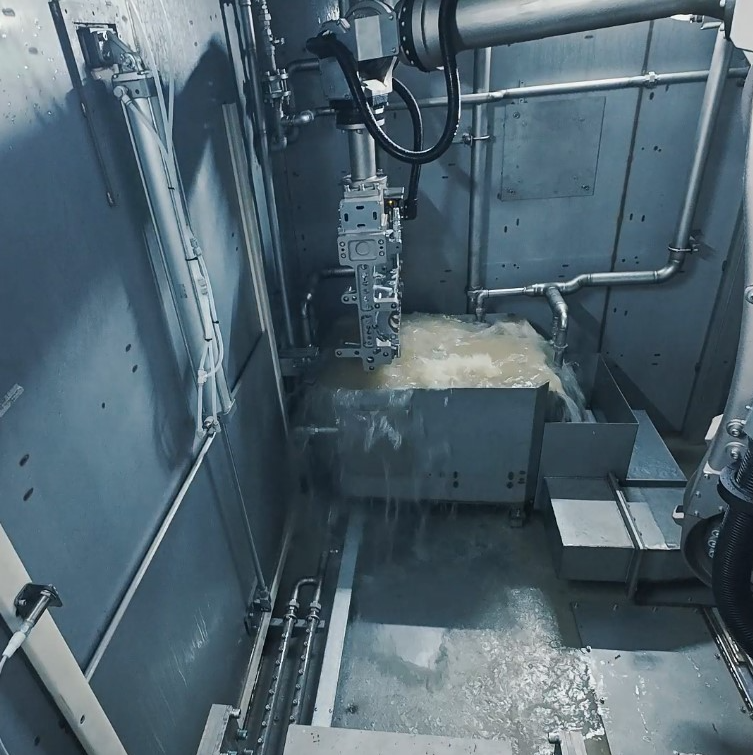
In order to ensure efficiency and effectiveness, the cleaning methods that are chosen must be appropriate to the materials, geometries, and types of contaminations being considered. Commonly used industrial cleaning methods include: cleaning with high pressure , cleaning using both manual and automatic cleaning and cleaning in cleaning agents. For industrially manufactured automotive components, specific technologies must be implemented to clean industrial automotive components like cylinders heads, crankshafts, and camshafts, which, if done using the wrong technology, will damage the cleanable surfaces of the part. If the wrong cleaning methodology is chosen, uneven surfaces and crevices will not be sufficiently cleaned, leading to reduced cleanliness of the emulsion and an increased cleaning cycle. Properly cleaning automotive components has been shown to achieve high, stable cleanliness in cleaning agents with properly identified workpiece features, leading to a notable reduction in cleaning time. Reduced cleaning time also reduces the amount of cleaning agents used.
Optimizing Agents and Parameters for Cleaning
Agent selection and parameter control influence results and costs directly. With regard to compatibility, soft metals can be protected by neutral formulas and heavy oils can be removed with alkaline detergents. Each individual case must be addressed when doing calibrations with respect to temperature, pressure, time, and flow rate. Heat increases emulsification, but excessive heating can damage components and shorten the life of the cleaning fluid. Extending the lifetime of cleaning fluid, and minimizing damage to components by properly setting the parameters will minimize waste. Consistent parameters will make results consistent, allowing for continuous improvements to be made. This optimization helps to keep the balance of cleanliness, cost, and environment for daily operations with sustainability.
Automation and Intelligent System Mesh
Intelligent systems and automation add a new dimension to cleaning, allowing for it to be a reliable, scalable step in production. Automated production lines experience less human error, and ensure consistent cycle times leading to high volume production. Intelligent modules are able to monitor parameters and make adjustments in real time, as well as record everything. Assembly can be done in a closed loop production line using vision inspection to ensure cleanliness. Automated systems ensure consistent quality throughout thousands of components for large scale automotive projects. This differentiation makes cleaning a smart, value-adding process instead of a standalone operation.
Effective Improvement Strategy
For future effectiveness, there needs to be continuous improvement, which is obtained through standardized management and monitoring. Facilities need specific operational rules, and schedules for training and maintenance. Some scheduled maintenance should include preventive checklists for performance saving nozzles, filters, and tank pestering equipment. Collecting important measurements will make visible the trend and optimization of those measurements. Teams should analyze results, and then others should be members of that same team. The process should be renewed. Periodic process audits determine how well the internal and statutory rules are adhered to. This improvement culture sustains a line of total cost performance and scalable growth.
Reliable Partner Support for Long Term Successful Operations
Profitable partnerships for industrial cleaning solutions are strengthened when providers are experienced. Harbin Big Bird Industrial proves designing and manufacturing to be profitable when businesses implement stable cleaning processes that are efficient, and partnerships profitable industrial cleaning for operational excellence.